7 Best Sales Tools for Startups in 2026: The Stack Guide


TL;DR
Most early-stage startups need exactly three sales tools: a CRM, an outreach platform, and a data source. HubSpot Free, Apollo.io, and Instantly.ai cover those bases for under $300/month. But tools alone don’t close deals. If you’re a founder stretched thin across sales, marketing, and product, a full-stack GTM execution partner like AgentWeb can replace four or five tools with a single system that actually ships campaigns. This guide breaks down the seven best sales tools for startups by stage, budget, and real-world user feedback, including the hidden costs nobody puts on their pricing page.
What Makes a Sales Tool Right for a Startup?
Startups don’t fail because they picked the wrong CRM. They fail because they bought six tools, connected none of them, and spent more time managing software than talking to customers. According to Mercury’s 2025 startup economics report, 66% of entrepreneurs find sales and marketing costs higher than anticipated. That gap between expected and actual cost isn’t just about subscription fees. It’s the time spent configuring workflows, cleaning data, and learning interfaces.
A good sales tool for a startup does three things. It delivers value in the first week, not after a month of onboarding. It grows with the team without forcing a platform migration at 10 employees. And it plays well with the other one or two tools already in the stack.
The 3-tool minimum framework: For most pre-seed to Series A companies, you need a CRM to track conversations, an outreach platform to start conversations, and a data source to find the right people. Everything else is a nice-to-have until revenue proves otherwise. If you’re wondering how to prioritize your sales and marketing channels, start with the channel that’s already producing signal, then tool up around it.
There’s also a question most listicles skip entirely: should you even be buying individual tools, or should you outsource execution? If your time as a founder is worth $500/hour, spending 10 hours a week clicking through LinkedIn profiles and tweaking email sequences is a negative-ROI activity. For some teams, the right answer isn’t more software. It’s a system that runs itself.
Explore AgentWeb’s AI marketing agent for startups →
Quick Comparison: Best Sales Tools for Startups at a Glance
| Tool | Starting Price | Best For | G2 Rating | Free Tier? | Key Differentiator |
|---|---|---|---|---|---|
| AgentWeb (Emma) | $199/mo (DIY) | Full GTM execution for startups | New | 7-day trial + free GTM audit | AI agent + senior operators; ships weekly campaigns |
| HubSpot Sales Hub | Free (up to 90% off Pro) | CRM foundation | 4.4/5 | Yes | All-in-one CRM platform; startup discounts |
| Apollo.io | Free / $49/user/mo | Outbound prospecting + sequencing | 4.7/5 (9,400+ reviews) | Yes | 265M+ contacts + sequences in one tool |
| Instantly.ai | $37/mo (flat fee) | High-volume cold email | 4.8/5 (3,400+ reviews) | No (14-day trial) | Unlimited email accounts per plan |
| Clay | $149/mo | Data enrichment | ~4.8/5 | Free (100 credits) | 150+ data providers in one workflow |
| LinkedIn Sales Navigator | $119.99/mo | Relationship B2B selling | N/A | 30-day trial | Only real-time LinkedIn data access |
| Lemlist | $63/user/mo (annual) | Personalized multichannel outreach | 4.6/5 (600+ reviews) | No (14-day trial) | Dynamic image/video personalization |
The 7 Best Sales Tools for Startups
1. AgentWeb (Emma)
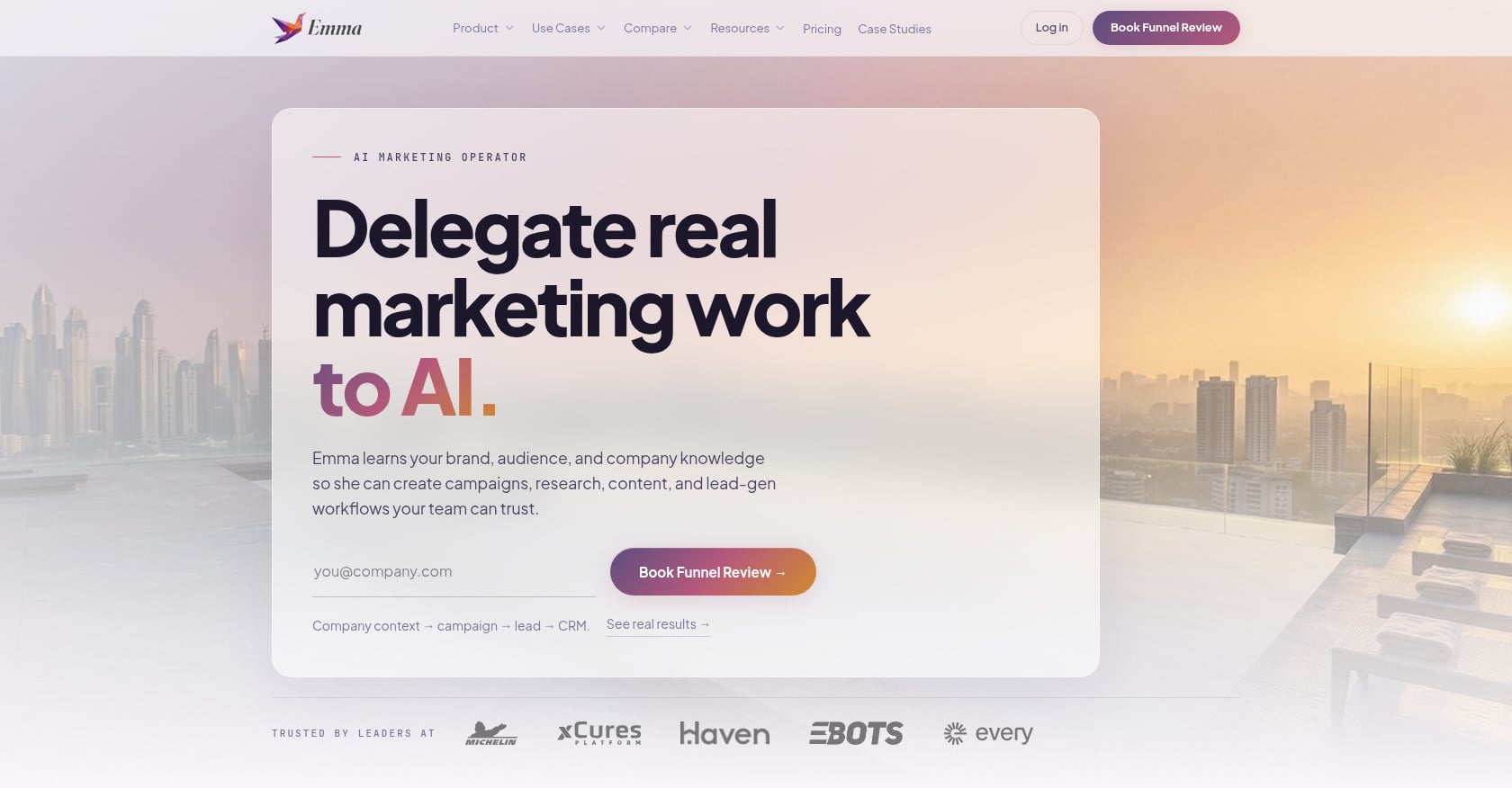
Best for: Pre-seed to Series A founders who need a functioning growth department without hiring a full team.
Every other tool on this list solves one piece of the sales puzzle. AgentWeb solves the system. Instead of buying a CRM, an outreach tool, an enrichment layer, and a content platform, then spending 20 hours a week managing all of them, AgentWeb’s agentic AI marketer “Emma” executes across Meta, Google, LinkedIn/X, email, and outbound in a single workflow.
Pricing:
- DIY (Self-Serve): 7-day free trial, then $199/month
- Custom Workflows (AI-Led Co-Pilot): Contact sales
- Done-For-You (Human-Led Growth Ops): Contact sales; 3-month engagement sprints
- Free GTM Discovery Report available before committing
Key features:
- Week 0 GTM diagnostic with a 90-day growth plan mapped to ICP and channels
- Multi-channel execution across paid, organic, email, and outbound
- Slack/Teams approval workflows (approve creative in one click)
- AgentWeb Portal with calendars, dashboards, and optimization loops
- Founder-brand support including LinkedIn ghostwriting and exec comms
- Up to ~20 content assets per month
- Weekly performance reviews and budget reallocation
Why it stands out for startups: The core dilemma every early-stage founder faces is that agencies execute but don’t lead, freelancers create but don’t scale, and hiring takes too long. AgentWeb sits in the gap. The done-for-you tier runs 3-month sprints, then hands back a repeatable system the team can maintain via self-serve.
Proof in practice: In a head-to-head test against a competing agency, AgentWeb generated 4,000+ leads and 328 add-to-carts in 3 months for Nailed It, hitting a 2.91% CTR at roughly $0.24 CPC. For Cora, a digital health startup, the platform achieved a 13.19% peak CTR on just $300/month in ad spend.
Tradeoffs:
- Newer platform with limited public third-party reviews
- Best fit for teams already using Slack or Teams who can engage weekly with approvals
- Services pricing requires contacting sales
See AgentWeb’s pricing and tiers →
2. HubSpot Sales Hub
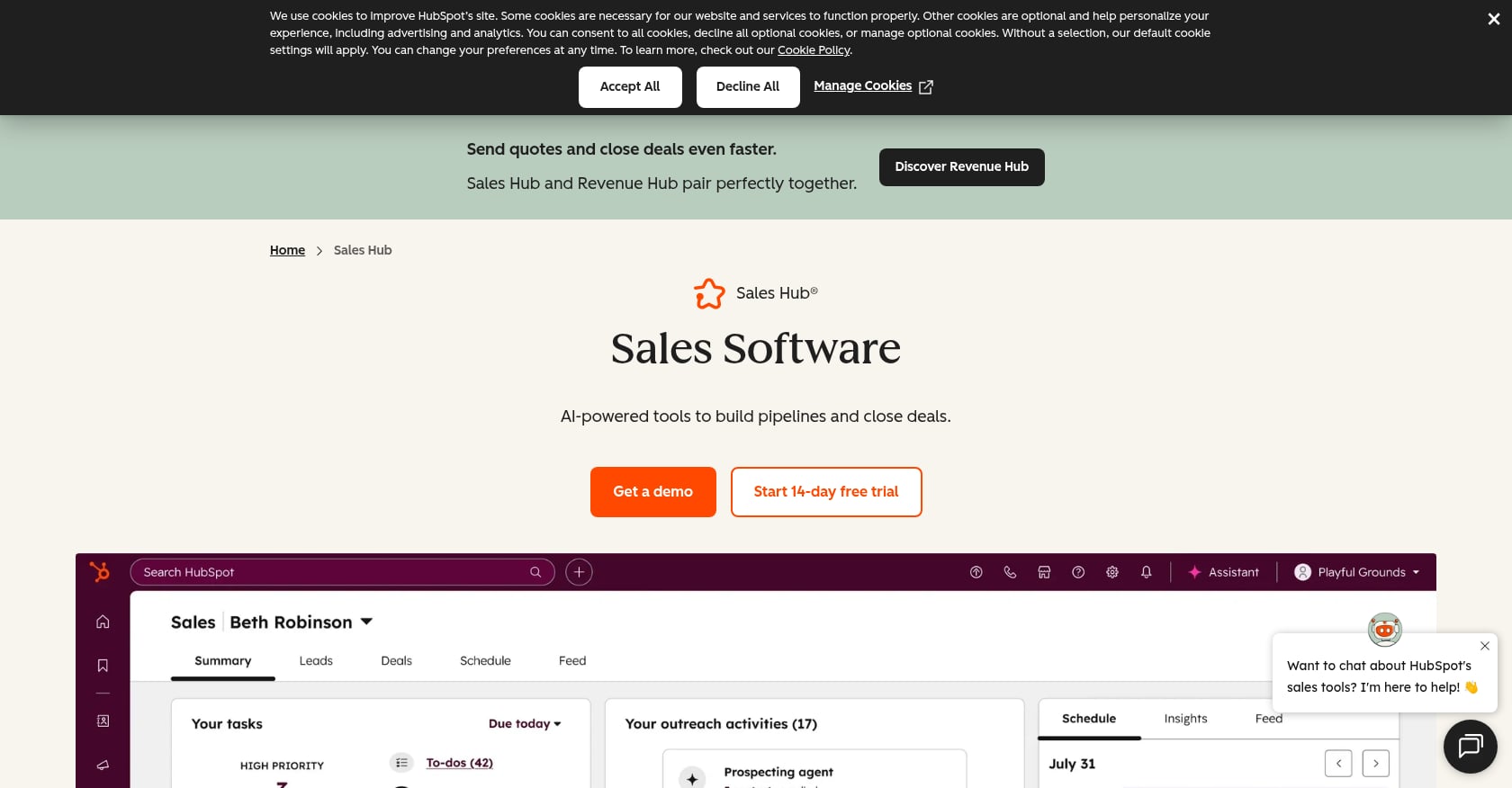
Best for: Solo founders and early-stage teams who need a free CRM foundation before they can afford specialized tools.
HubSpot is the default CRM for startups for a reason. The free tier is genuinely useful, not a demo dressed up as a product. You get contact management, deal tracking, email tracking, and meeting scheduling without spending a dollar.
Pricing:
- Free: $0 (no credit card required)
- Starter: $20/user/month
- Professional: $100/user/month
- Enterprise: $150/user/month
- HubSpot for Startups: up to 90% off Year 1 for companies that have raised under $20M in Pre-seed, Seed, or Series A funding
That startup discount is significant. A startup otherwise paying $18,000/year for Marketing Hub Professional would pay under $2,000 in the first year.
Key features:
- Free CRM with unlimited contacts
- Email tracking and notifications
- Meeting scheduling (rated 9.0/10 by reviewers)
- Deal pipeline management
- Email sequences (Starter and above)
- Breeze AI agents for prospecting and content (newer addition)
Real user perspective: Reviewers consistently praise HubSpot’s meeting scheduling and calendar integrations. The free tier works well for founders running early sales conversations and tracking deals manually.
Tradeoffs:
- The free plan lacks sequences, meaningful automation, and custom reporting
- Your bill multiplies roughly 10x between Year 1 and Year 3 if you’re on the 90% discount tier
- Limited B2B contact database compared to Apollo
- Feature gating pushes upgrades faster than most startups expect
3. Apollo.io
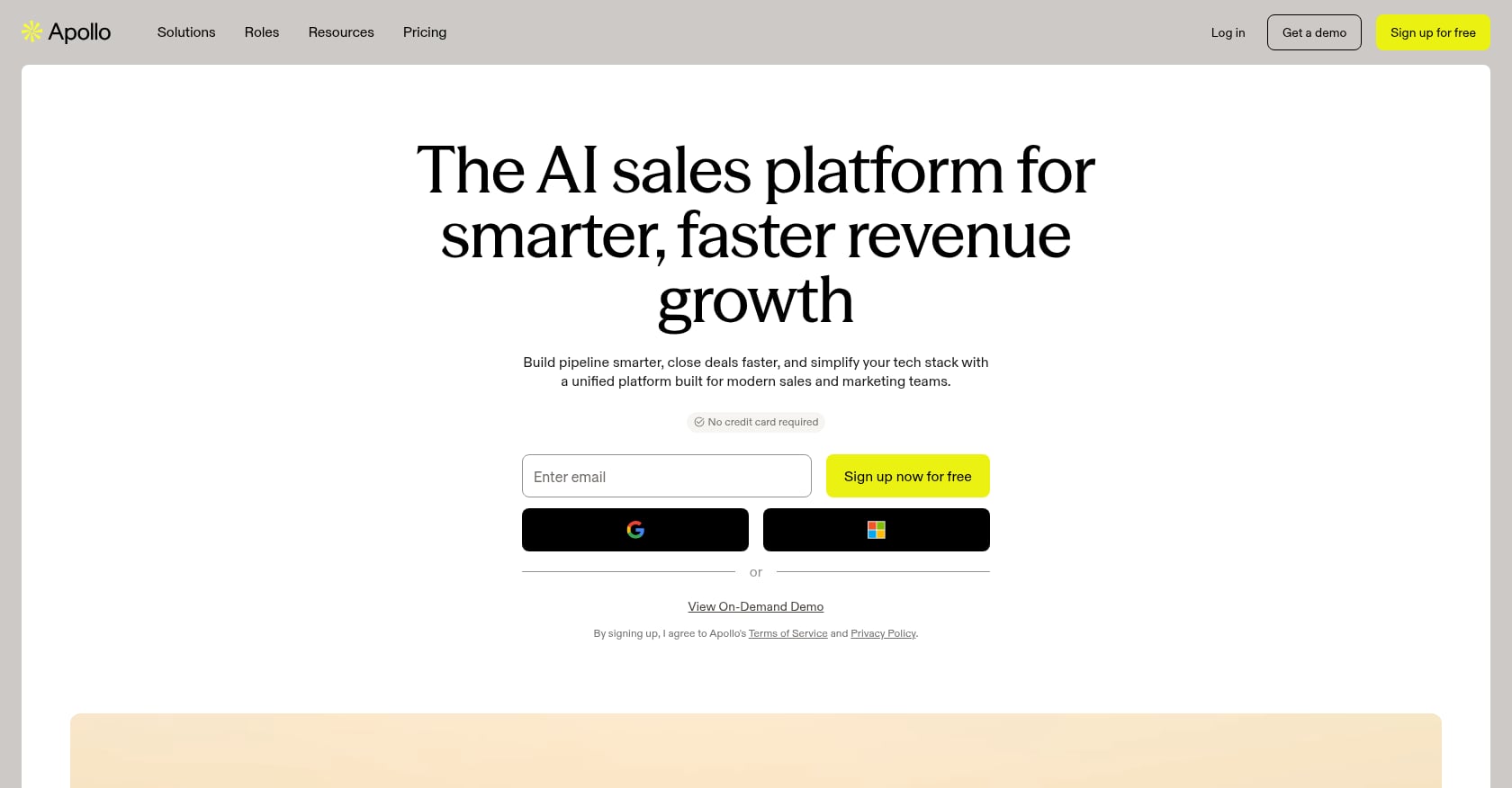
Best for: Startups running outbound-first sales who need prospecting data and email sequencing in one platform.
Apollo combines what would normally be two or three separate tools: a contact database, an email sequencer, and a basic CRM. With 265M+ contacts and 65+ search filters, it’s the most popular all-in-one prospecting platform for startups, holding a 4.7/5 rating on G2 from over 9,400 reviews.
Pricing:
- Free: 600 email credits/year, basic features
- Basic: $49/user/month (annual billing)
- Professional: $79/user/month (annual)
- Organization: $119/user/month (annual)
Key features:
- 265M+ contact database with 65+ filters
- Multichannel sequences (email + LinkedIn + calls)
- Built-in dialer
- AI email writer
- Buyer intent signals
- CRM pipeline tracking
Real user perspective: Practitioners on Reddit and G2 consistently flag data accuracy as the biggest issue. While Apollo claims 91% email accuracy, real-world users report bounce rates between 5% and 25% depending on geography. For US-based tech and SaaS contacts, the data is generally solid. For international markets or niche industries, accuracy drops noticeably. On Trustpilot, Apollo sits at just 2.9/5, with recurring complaints about billing practices and slow support on lower-tier plans.
If you’re planning to run serious outbound using Apollo, read up on B2B cold outreach strategies to maximize the contacts you’re paying for.
Tradeoffs:
- No native email warm-up. Sending more than 50 to 100 cold emails per day without a warm-up tool risks deliverability
- Credit system is complex, and credits expire monthly
- Cost-to-value satisfaction scored 77/100 in SoftwareReviews, the lowest in the entire scorecard
- Data quality varies significantly outside the US tech ecosystem
4. Instantly.ai
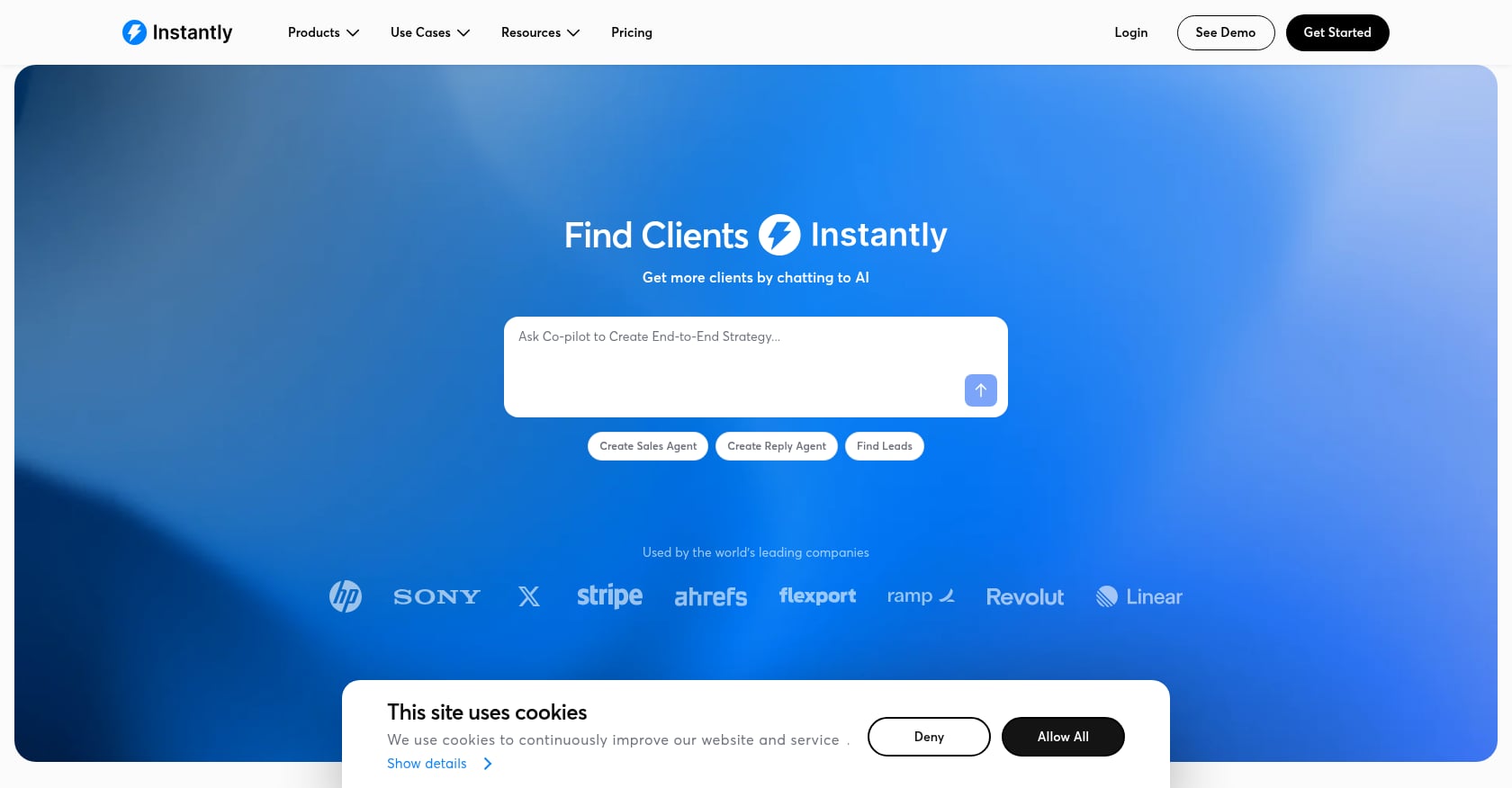
Best for: Teams where cold email is the primary outbound channel and they need flat-fee pricing for unlimited inboxes.
Instantly earned its reputation by solving a specific problem: sending high-volume cold email without per-seat pricing. Every plan includes unlimited email accounts, unlimited warm-up, and unlimited team seats. Pricing scales by volume, not by user count. That model has earned it a 4.8/5 on G2 across 3,400+ reviews.
Pricing (headline vs. reality):
- Growth: $47/month (5,000 emails, 1,000 contacts) or $37.60/month billed annually
- Hypergrowth: $97/month (100,000 emails, 25,000 contacts)
The hidden cost problem: The advertised $37.60/month price stacks to roughly $150/month once you add SuperSearch, CRM, and Inbox Placement. Multiple practitioners on Reddit describe this as a “bait-and-switch feeling,” where the modules an outbound team actually needs triple or quadruple the headline price.
For a deeper look at AI email tools for cold outreach, including deliverability tactics, that guide covers the full picture.
Key features:
- Unlimited email accounts and warm-up per plan
- Email sequence builder with A/B testing
- Deliverability network (Unibox inbox rotation)
- Lead finder (separate paid add-on)
- Analytics dashboard
Real user perspective: Some users report having access only to an AI bot and a weekly webinar for support, with no meaningful human help. Complaints about slow or unhelpful responses appear regularly on Reddit and Trustpilot.
Tradeoffs:
- Email-only platform (no native LinkedIn automation)
- CRM and lead database are separate paid products
- Awkward gap between tiers: you jump from 5,000 emails/month straight to 100,000, with nothing in between
- Realistic monthly spend runs 3 to 4 times the advertised starting price
5. Clay
Best for: RevOps-savvy teams running large outbound campaigns with complex enrichment needs across multiple data providers.
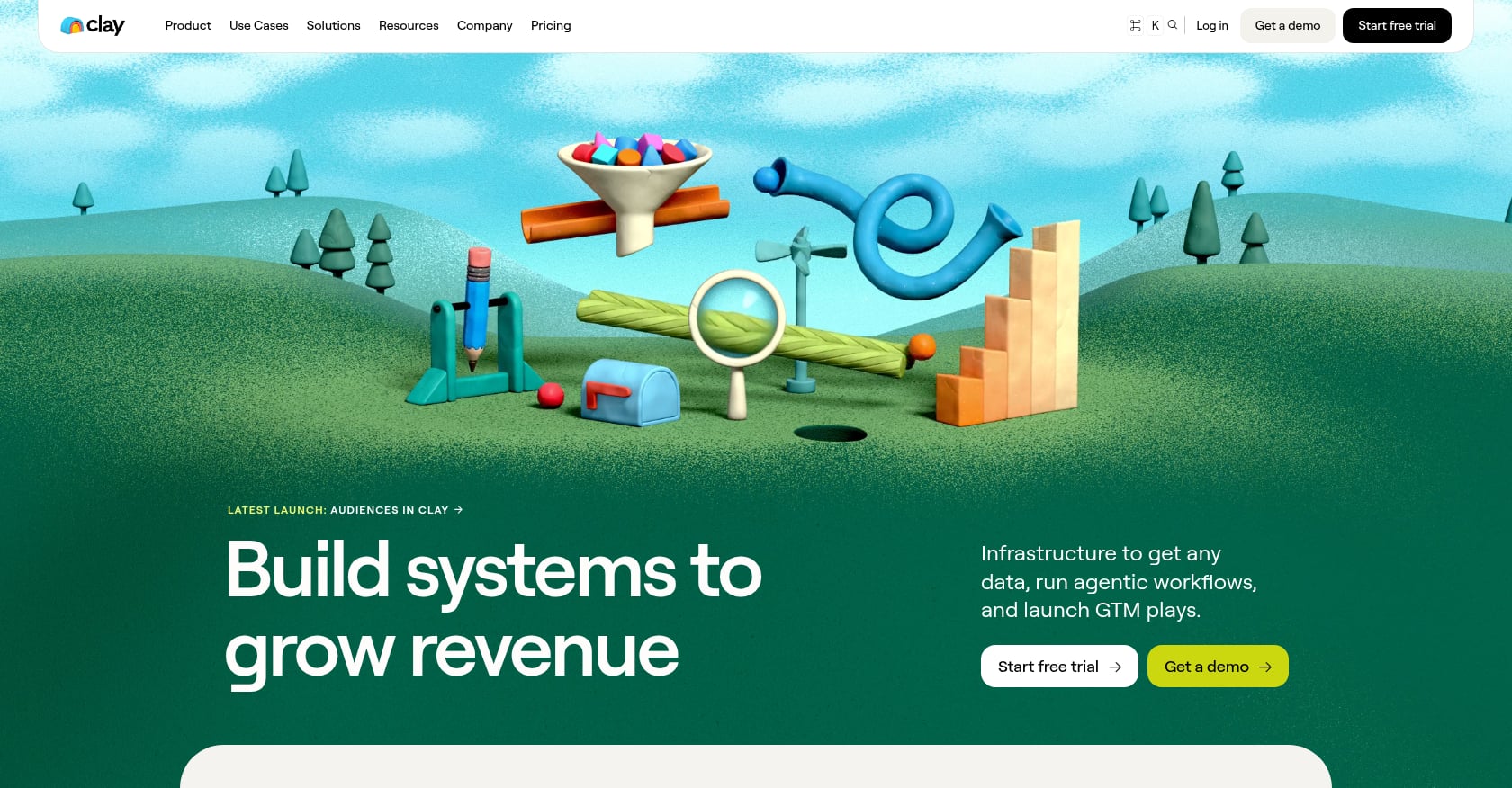
Clay isn’t a sales engagement platform. It’s a data enrichment workflow builder that pulls from 150+ data providers, letting you waterfall through sources until you find a verified email or company signal. For teams that outgrow Apollo’s built-in data, Clay fills the gaps.
Pricing:
- Free: 100 credits/month
- Starter: $149/month ($134 annual)
- Median enterprise contract lands around $30,400/year according to Vendr, with outliers reaching $154,000
Key features:
- 150+ data provider integrations
- Waterfall enrichment (automatically tries multiple sources)
- AI-powered research agent (Claygent)
- Custom workflow builder
- CRM integrations (Pro+ only)
Real user perspective: Reviewers on G2 and Reddit consistently report 20 to 40 hours to build a first production-ready workflow. The credit-based pricing is difficult to predict. If you run a large list with too many enrichment steps, credits disappear fast. For teams considering AI-powered lead research alternatives, it’s worth comparing the time investment.
Tradeoffs:
- Steep learning curve: 2 to 4 weeks before most teams are productive
- Not a sending tool. You still need separate platforms for email, LinkedIn, and domain warm-up
- Credit costs are unpredictable for variable-volume teams
- For solo founders or teams under 3 people enriching fewer than 500 contacts monthly, Apollo at $49 to $99/month typically provides better value
6. LinkedIn Sales Navigator
Best for: Founder-led B2B sales where warm intros and relationship building drive deals over $5K.
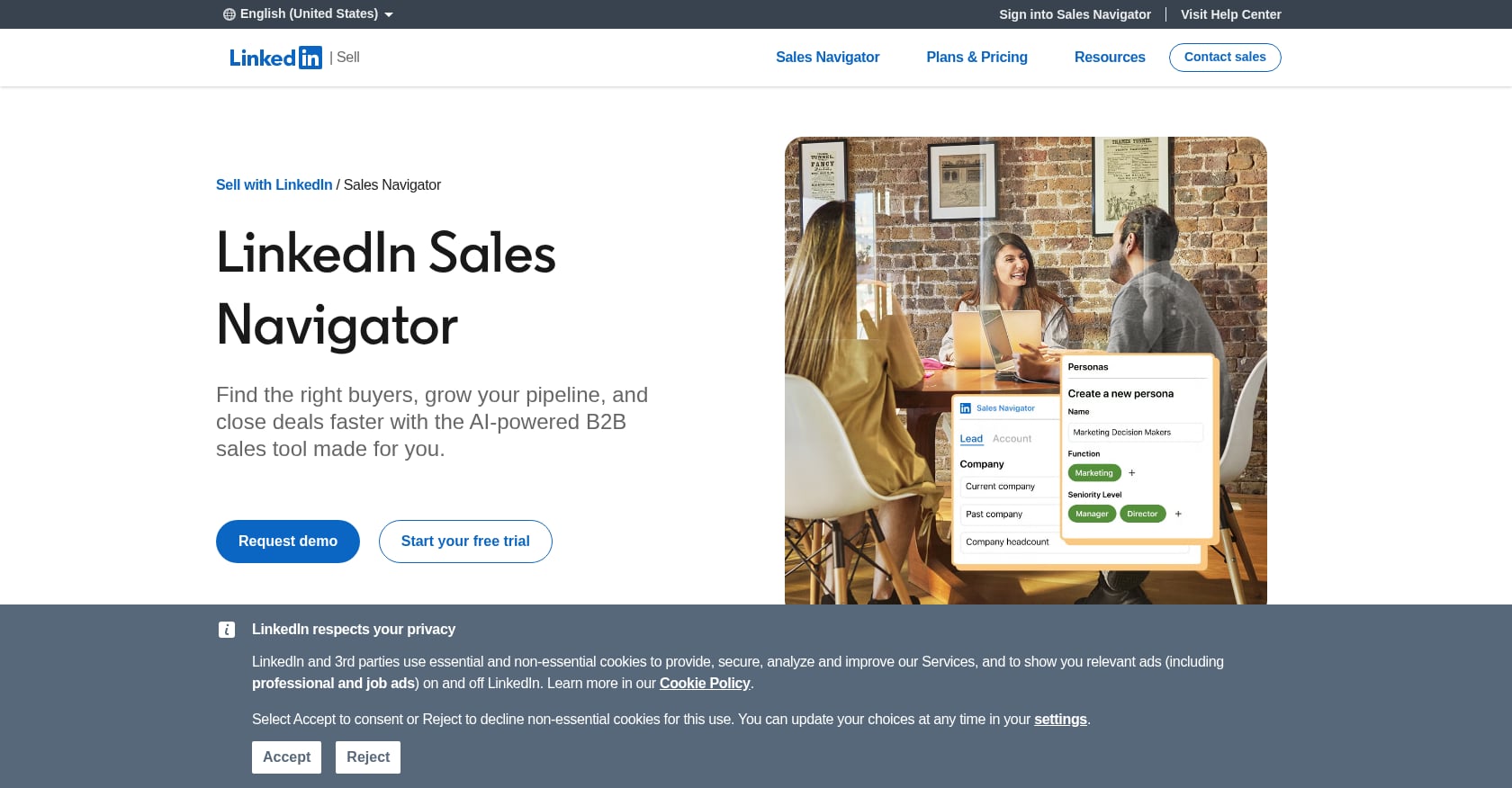
LinkedIn Sales Navigator remains the gold standard for B2B prospecting data, for one simple reason: it’s the only database in the world that’s self-updating. People update their own profiles when they get promoted, change companies, or take on new responsibilities. No other data provider can match that freshness. A Forrester study found Sales Navigator yields 312% ROI over 3 years for organizations that use it systematically.
Pricing:
- Core: $119.99/month, or $89.99/month effective on annual billing ($1,079.88/year)
- Advanced: $159.99/month
- Advanced Plus: Custom pricing starting around $1,600/seat/year
Key features:
- 40+ advanced search filters
- Unlimited searches (unlike free LinkedIn’s commercial use limits)
- 50 InMails per month
- Buyer intent alerts
- Smart Links for tracking content engagement
- Saved lead lists with change alerts
Tradeoffs:
- Does not provide verified business email addresses. You still need an enrichment tool like Apollo to get the email
- No data export, your data stays locked inside LinkedIn
- Per-seat pricing compounds quickly for growing teams
- Excellent at finding people and warm paths, but it doesn’t research accounts, score fit, or draft outreach
7. Lemlist
Best for: Teams of one to five named senders doing genuine personalization across email, LinkedIn, and calls.
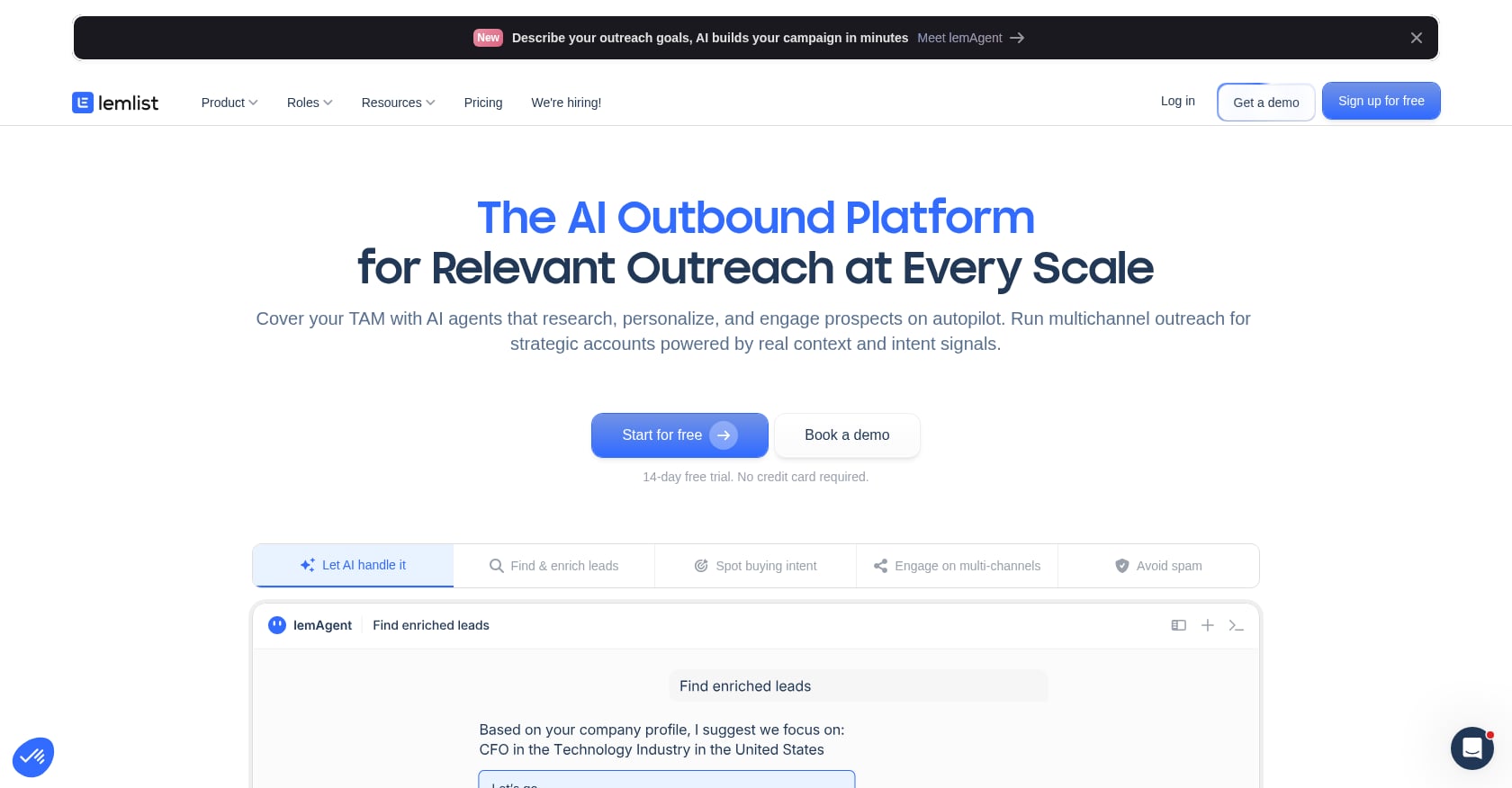
Lemlist’s standout feature is dynamic personalized images and videos embedded directly in emails. Instead of “Hey {first_name},” your prospect sees their name on a whiteboard, a coffee cup, or a mockup. It’s a gimmick, but it works. The platform holds a 4.6/5 on G2 with 600+ reviews, with users consistently highlighting the personalization features and visual sequence builder.
Pricing:
- Email Pro: $79/user/month ($63 annual)
- Multichannel Expert: $109/user/month ($87 annual)
- Extra email senders: $9/email/month
Key features:
- Dynamic personalized images and videos in emails
- Multichannel sequences (email + LinkedIn + calls + SMS + WhatsApp)
- 650M+ lead database
- Built-in warm-up (lemwarm)
- Visual sequence builder
Tradeoffs:
- Per-user pricing makes scaling expensive. Adding a fifth sender at the Multichannel tier costs $435+/month
- The Email Pro plan does not include LinkedIn automation. You must upgrade to Multichannel Expert, which delivers LinkedIn via a Chrome extension rather than native automation
- Extra sender fees ($9/email/month) add up fast for cold email at scale
If you want to improve reply rates regardless of which outreach tool you use, this guide on writing outbound emails that get replies covers the fundamentals.
How to Build Your Startup Sales Stack by Stage
The best sales tools for startups aren’t the same at every stage. A pre-seed founder bootstrapping with personal savings has different needs than a Series A company with $5M in the bank and a quota-carrying sales team. Here’s a concrete framework.
Seed Stage (Budget: Under $100/month)
Stack: HubSpot Free + Apollo Free + Manual Outreach
At this stage, the goal is learning, not automation. You’re trying to figure out who your customer is, what message resonates, and which channel produces signal. HubSpot Free gives you deal tracking. Apollo Free gives you 600 email credits per year to test outbound. Manual LinkedIn outreach fills the gaps.
Total cost: $0/month.
If your budget is truly minimal, this guide on getting leads on a small budget covers tactics that don’t require paid tools at all.
Pre-Series A (Budget: $200 to $500/month)
Stack: HubSpot Starter ($20/user) + Apollo Basic ($49/user) + Instantly Growth ($47/month)
Now you have some revenue or funding and need to increase outbound volume. HubSpot Starter unlocks sequences and basic automation. Apollo Basic gives you more credits and better filters. Instantly handles email delivery at scale with unlimited warm-up.
Total cost: ~$116 to $300/month depending on team size.
Watch for hidden costs here. Instantly’s realistic all-in spend is 3 to 4x the headline price once you add the modules you actually need. Budget accordingly.
Series A (Budget: $500 to $2,000/month)
Stack Option A: HubSpot Professional + Apollo Professional + Clay Starter + Lemlist Multichannel
This is the full DIY stack. You get CRM automation, enriched prospecting data, waterfall enrichment for hard-to-reach contacts, and personalized multichannel outreach. But you also need someone spending 15 to 20 hours per week managing these tools.
Total cost: ~$400 to $800/month in software, plus significant time investment.
Stack Option B: AgentWeb Done-For-You
Instead of assembling and managing four or five tools, a full-stack GTM execution partner runs multi-channel campaigns from Day 1. The 3-month sprint model means you’re not locked into an annual contract, and you leave with a repeatable system.
The median early-stage startup uses 4 to 5 sales tools simultaneously. The question isn’t which tools to buy. It’s whether you have the bandwidth to run them all.
When Tools Aren’t Enough: The Case for GTM Execution Partners
Here’s a pattern that plays out at hundreds of startups every quarter. The founder buys Apollo, sets up HubSpot, signs up for Instantly, maybe adds Clay. The first week, everything feels promising. By week four, the sequences are stale, the CRM is half-updated, the enrichment credits are running low, and nobody has time to analyze what’s working.
Tools multiply, but outcomes don’t.
The problem isn’t the individual tools. Each one reviewed in this article is good at what it does. The problem is that running a sales and marketing engine requires system-level thinking, constant iteration, and channel expertise that most founding teams don’t have the bandwidth to provide. Teams using AI-driven sales automation see a 76% boost in win rates, but only when the automation is actually maintained and optimized.
This is where a full-stack execution model makes sense. Instead of a founder spending 10 to 15 hours per week as an amateur RevOps engineer, a service like AgentWeb deploys an AI agent backed by senior operators who ship campaigns weekly across paid, organic, email, and outbound. The 90-day sprint model validates what works, then transitions to a self-serve system the team can run independently.
For founders weighing whether to compare AI SDR vs. SDR agency costs, the math often favors execution partners when your team has fewer than three people focused on growth.
The global sales management software market is projected to reach $202 billion by 2034. More tools will keep appearing. The startups that win won’t be the ones with the most subscriptions. They’ll be the ones that convert tools into pipeline fastest.
Start with a free GTM discovery report →
FAQ
What is the best free sales tool for startups?
HubSpot Sales Hub Free is the strongest free option for CRM and deal tracking. Apollo.io Free adds 600 email credits per year for outbound prospecting. Together, they cover the basics without any spend. AgentWeb also offers a free GTM Discovery Report that gives you a diagnostic before committing to any tools.
How much should a startup spend on sales tools?
At the seed stage, $0 to $100/month is appropriate. Pre-Series A, budget $200 to $500/month. At Series A, $500 to $2,000/month is common for a full stack. The bigger cost is often time: managing 4 to 5 tools can eat 15 to 20 hours per week of founder time.
Can AI replace SDRs for startups?
AI can handle prospecting, initial outreach, and lead scoring effectively. Tools like Apollo’s AI email writer and AgentWeb’s Emma agent automate tasks that used to require a dedicated SDR. But complex deals, relationship building, and nuanced objection handling still need human judgment. The sweet spot for most startups is AI handling volume work while founders handle high-value conversations.
What are the hidden costs in startup sales tools?
Credit-based pricing (Apollo, Clay) makes costs unpredictable. Instantly’s modular billing turns a $37/month headline into $150/month in practice. HubSpot’s startup discount drops 90% after Year 1, creating sticker shock at renewal. Sales Navigator doesn’t include email data, requiring a separate enrichment tool. Always calculate the all-in cost for your specific workflow before committing.
Should I buy individual sales tools or use a full-service GTM partner?
If you have a dedicated sales or RevOps person with 15+ hours per week to manage tools, DIY can work. If you’re a founder wearing five hats, a GTM execution partner like AgentWeb typically delivers faster time-to-pipeline because you’re paying for outcomes and systems, not software licenses you need to figure out yourself.
What’s the best sales tool for startups doing outbound in 2026?
For pure cold email volume, Instantly.ai offers the best per-email economics with unlimited accounts. For combined prospecting and sequencing, Apollo.io gives you data and outreach in one platform. For personalized multichannel (email plus LinkedIn plus calls), Lemlist is the strongest option. The right choice depends on your primary channel and team size.
How do I avoid tool sprawl as my startup grows?
Start with the 3-tool minimum: CRM, outreach platform, data source. Add new tools only when you’ve maxed out the current stack’s capacity, not when a new feature looks shiny. Audit your stack quarterly. If any tool hasn’t been used meaningfully in 30 days, cancel it. Better yet, consider a platform approach (HubSpot’s ecosystem or AgentWeb’s full-stack model) that reduces integration overhead.
Is LinkedIn Sales Navigator worth it for startups?
At $90 to $120/month per seat, Sales Navigator is worth it if your average deal size exceeds $5K and your buyers have active LinkedIn profiles. For founder-led B2B sales where warm introductions matter, it’s hard to replace. For high-volume outbound to SMBs, the money is better spent on Apollo or Instantly.
Or get a free AI Readiness Roadmap to see where your GTM has gaps.
Ex-Meta, Google, LinkedIn. 10+ years in ML & data science for GTM. Expert in customer acquisition and growth activation.
Get a free Stack Review.
30 min with Harsha and Matt.
We audit your last 30 days, pinpoint the highest-impact fixes, and hand you the exact playbook we'd run. No deck. No pitch unless there's a fit.