Generative AI for Sales and Marketing: 10 Best Tools (2026)


TL;DR
Generative AI for sales and marketing has gone mainstream, with 87% of marketers now using it in at least one workflow. The biggest problem isn’t finding a tool. It’s picking the right combination without drowning in subscriptions. This guide covers 10 tools across content creation, CRM intelligence, conversation analytics, data enrichment, and the emerging “agentic AI + human operator” category, with real pricing, honest tradeoffs, and a decision framework based on team size and budget.
How Generative AI Is Reshaping Sales and Marketing
Before jumping into tools, it helps to understand what “generative AI” actually means in a sales and marketing context, because the term gets thrown around loosely.
Generative AI creates new content: emails, ad copy, blog posts, images, video scripts. Predictive AI, by contrast, analyzes existing data to forecast outcomes like lead scores, churn risk, or deal probability. Most modern platforms blend both, but knowing which capability you actually need prevents buying the wrong tool.
The use cases that matter most right now fall into five buckets: content creation at scale, email personalization, conversation intelligence for sales calls, lead data enrichment, and full campaign orchestration across channels. According to McKinsey, generative AI could unlock $0.8 to $1.2 trillion in annual value across sales and marketing functions alone.
The real pain point, though, isn’t the AI output quality. Practitioners on Reddit and in G2 reviews consistently say the same thing: teams end up stitching together five or six point tools (one for enrichment, one for writing, one for CRM, one for email coaching) with no orchestration layer connecting them. This tool sprawl creates more overhead than it saves. The strongest tools are those that fit into existing workflows and help teams move faster without sacrificing brand quality.
This is why a new category is emerging: agentic AI for go-to-market, where autonomous agents handle multi-step campaigns while humans steer strategy and approvals. Already, 34% of enterprise marketing teams run at least one autonomous agent in production, more than double the 14% reported in late 2025.
At-a-Glance Comparison Table
| Tool | Starting Price | Best For | Key Strength | Key Limitation | Category |
|---|---|---|---|---|---|
| AgentWeb / Emma | $199/mo (DIY) | Startups needing full GTM execution | AI + human operators, weekly shipping | Limited public case studies | Agentic GTM execution |
| Jasper | $59/mo | Marketing content teams (3+) | Brand voice consistency | Content only, no campaign execution | Content platform |
| Copy.ai | $0–$49/mo | High-volume ad copy + outreach | GTM workflow automation | Credit burn, long-form quality issues | GTM AI platform |
| HubSpot Breeze | $0–$4,700+/mo | HubSpot-committed teams | CRM-native context, outcome pricing | Deep ecosystem lock-in | CRM AI suite |
| Salesforce Einstein | $50/user/mo add-on | Enterprise Salesforce orgs | Pipeline scoring + generative email | Expensive, Salesforce-only | CRM AI suite |
| Gong | ~$1,400/seat/yr | Sales orgs with 30+ reps | Conversation analytics + deal intelligence | Opaque pricing, overkill for startups | Revenue intelligence |
| Clay | $185/mo (Launch) | RevOps building outbound systems | Multi-source data enrichment | Steep learning curve, not a sending tool | Data enrichment |
| ChatGPT / Claude | $20/mo (Plus) | Prompt-savvy solo operators | Cheapest, broadest capabilities | No workflow, no brand guardrails | General LLM |
| Lavender | $29/mo | SDR teams focused on cold email | Real-time email coaching | Narrow scope, email only | Email coaching |
| Hootsuite AI | $99/mo | Social-first marketing teams | Scheduling + AI content suggestions | Weak on sales use cases | Social management |
The Full List: 10 Best Generative AI Tools for Sales and Marketing
1. AgentWeb / Emma
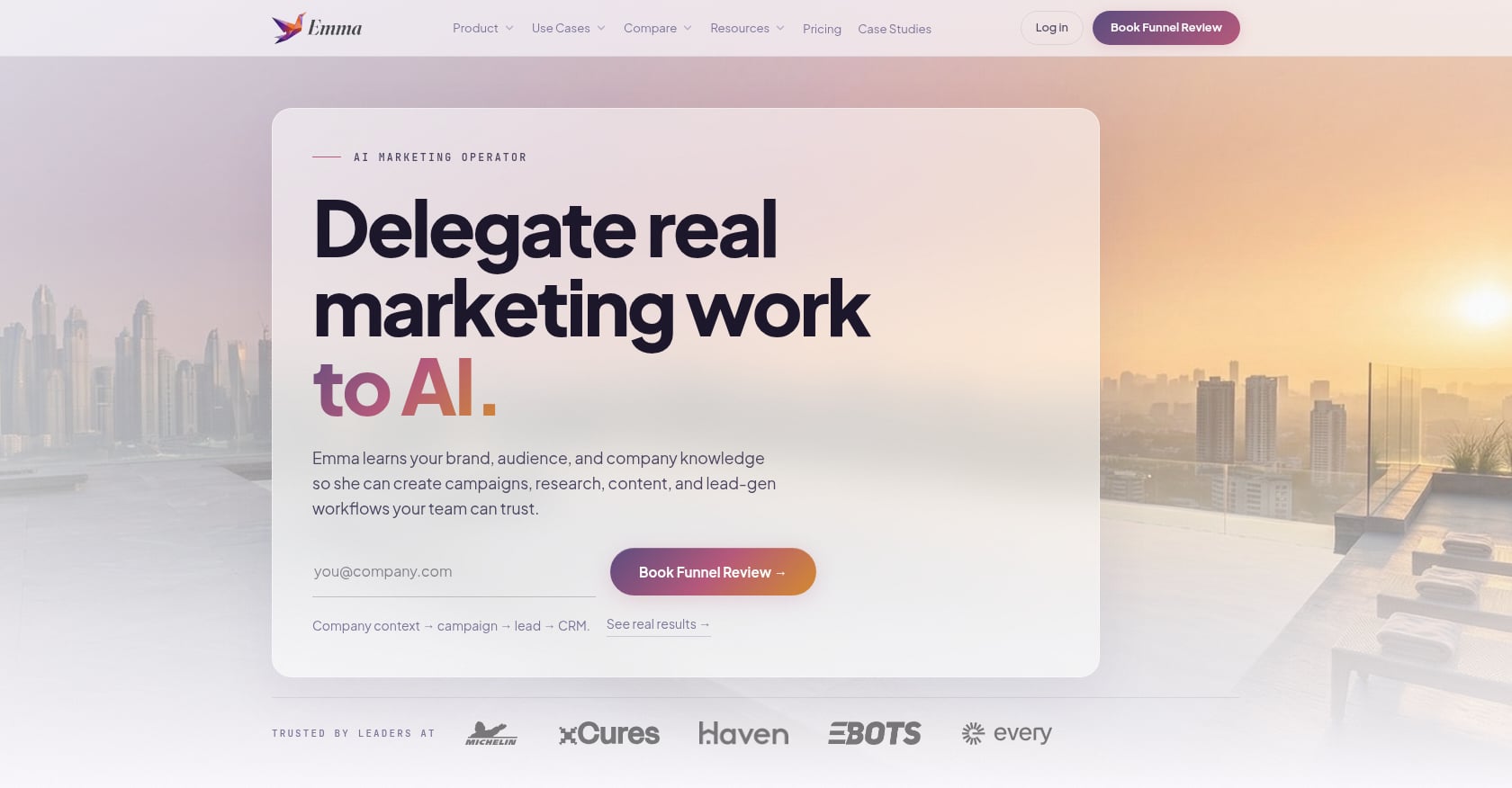
Best for: Pre-seed to Series A startups that need weekly shipped campaigns, not another SaaS login to manage.
What it is: AgentWeb is an AI + human go-to-market execution service and platform. Its agentic AI marketer, “Emma,” handles research, planning, creative production, and reporting across channels, while a senior operator team leads strategy from day one. This sits in a category most listicles completely miss: the agentic AI + human operator hybrid. It’s not a writing tool, not a standalone SaaS, and not a traditional agency.
Pricing:
- DIY Self-Serve: 7-day free trial, then $199/month
- Custom Workflows (AI-led co-pilot): seasonal, contact sales
- Done-For-You (human-led growth ops): seasonal, contact sales
See full pricing details here.
Key features:
- Week-0 diagnostic that produces a concrete 90-day GTM plan mapped to ICP, channels, and bottlenecks
- Multi-channel execution across Meta, Google, LinkedIn/X, email, and outbound
- Slack/Teams approval workflows for one-click creative sign-off
- Founder-brand support including LinkedIn ghostwriting
- Transition path from full-service to self-serve with proven templates
Proof:
- Nailed It (consumer beauty AI): 4,000+ leads and 328 Add-to-Carts in 3 months, 2.91% CTR at ~$0.24 CPC
- Cora (digital health): 13.19% CTR peak on a $300/month ad budget
You can read more about these results on the AgentWeb case studies page.
Tradeoffs:
- Pricing for service tiers isn’t fully public
- Limited published case studies compared to larger platforms
- Best fit for teams willing to engage weekly via Slack/Teams; hands-off buyers may see less fit
Why it matters: SaaStr has described a future where sales teams are “50/50,” half human, half AI. AgentWeb is already operating this way on the marketing side. For founders who’ve tried assembling a stack of point tools and found the coordination burden worse than the problem they were solving, this model is worth serious consideration.
2. Jasper AI
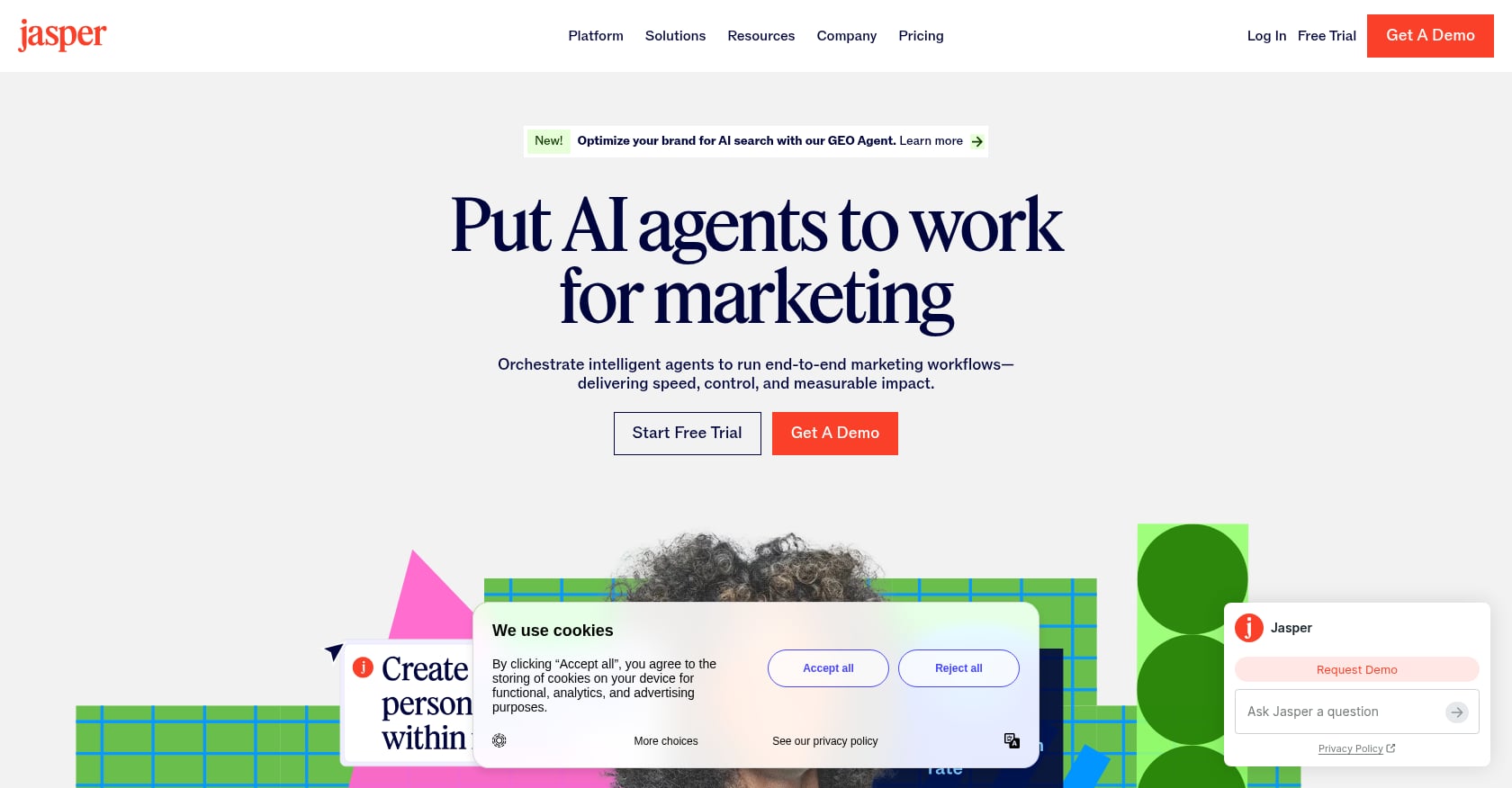
Best for: Marketing teams of 3+ people producing 15+ content pieces per month where brand consistency across writers is a real challenge.
What it is: Jasper is a content operations layer built on top of large language models. It doesn’t have its own proprietary AI model. Instead, it routes prompts through OpenAI and Anthropic models, then wraps the output in marketing-specific structure: templates, brand guardrails, review workflows, and a shared asset library.
Pricing:
- Pro: $59/month (billed annually) or $69/month (monthly), includes unlimited AI words, 3 brand voices, and marketing templates
- Business: custom pricing, typically starting around $900/month for small teams
Key features:
- Brand Voice system that enforces tone across multiple writers
- Marketing-specific templates for ads, emails, landing pages, and blog posts
- Campaign workflow tools for team collaboration
- Integration with Surfer SEO for content optimization
Tradeoffs:
- Content production only. Jasper doesn’t execute campaigns, send emails, or manage ads.
- Headline pricing hides real costs: the Surfer SEO subscription, per-seat scaling, and Brand Voice caps push teams into custom pricing faster than expected.
- Solo creators or teams already proficient with ChatGPT or Claude will find limited added value.
User perspective: The common advice in practitioner communities is that Jasper is worth the price if you’re coordinating content across multiple writers. If you’re a solo operator who knows how to prompt well, you’re paying for guardrails you may not need. For teams building out their content marketing strategy, though, the brand voice controls can save hours of editing.
3. Copy.ai
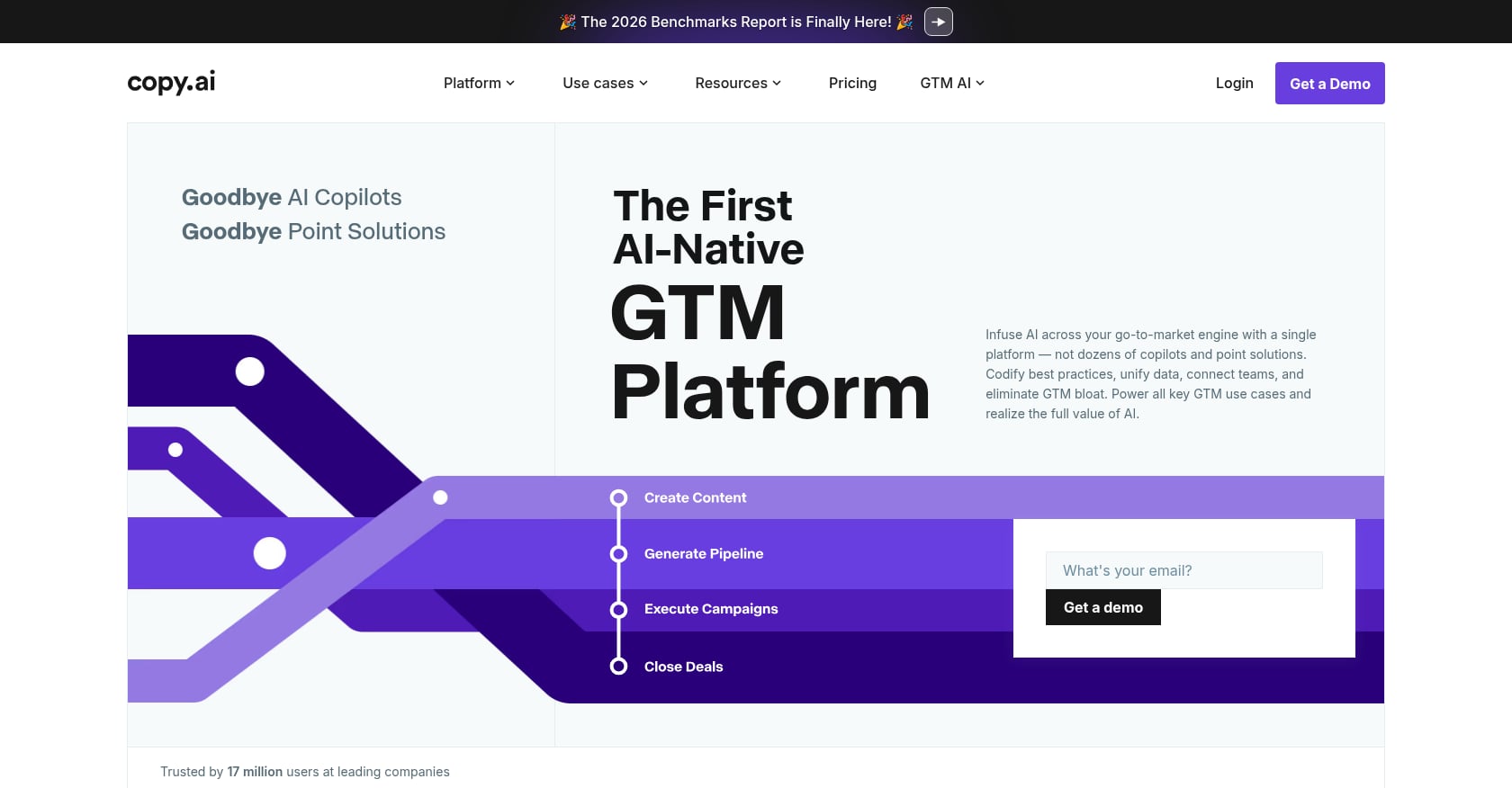
Best for: Sales and marketing squads doing high-volume ad copy plus automated prospecting workflows.
What it is: Copy.ai started as a GPT-3 powered copywriting tool and has evolved into a full GTM execution layer. It now combines AI writing, workflow automation, and deep integrations to support sales, marketing, and RevOps teams in a single platform.
Pricing:
- Free: $0/month (2,000 words)
- Starter: $49/month (unlimited words)
- Advanced: $249/month (up to 5 seats)
- Enterprise: custom
Key features:
- Short-form copy generation (ads, product descriptions, social posts) remains strong
- GTM workflow builder for automating prospecting sequences
- Integrations with CRMs and sales tools
- AI agents for specific tasks like lead research and competitive analysis
Tradeoffs:
- Blog posts and long-form content come out generic. Practitioners on Reddit report rewriting 40–60% of every long-form draft.
- Credits are the top complaint in reviews. Not output quality, but credit burn. Workflow runs eat credits fast, and spending is hard to forecast.
- The GTM pivot added complexity. Simple copywriting is still intuitive, but workflows, agents, and tables have a steep learning curve.
User perspective: One practitioner shared that Copy.ai excels at short-form but falls apart for anything requiring depth. The consensus: use it for what it’s good at (ad copy, email subject lines, product descriptions) and don’t force it into long-form territory.
4. HubSpot Breeze AI

Best for: Sales-led teams already on HubSpot Pro or Enterprise who want AI grounded in their CRM data.
What it is: HubSpot Breeze is a suite of three AI capabilities embedded across the HubSpot platform. Breeze Assistant is a generative AI helper available everywhere in HubSpot. Breeze Agents are autonomous AI teammates for specific multi-step jobs. Breeze Intelligence enriches contact records, flags buyer intent signals, and shortens forms.
Pricing:
HubSpot moved to outcome-based pricing in April 2026. The range runs from $0/month (basic features in free CRM) to $4,700+/month for full Enterprise usage. Specific costs:
- Customer Agent: $0.50 per resolved conversation
- Prospecting Agent: $1.00 per recommended lead
As HubSpot’s chief customer officer Jon Dick put it: “Too often, that means paying for potential rather than performance. Outcome-based pricing removes that risk.”
Key features:
- AI-generated prospect research and follow-up emails grounded in CRM context
- Autonomous prospecting agent that recommends leads based on your existing customer data
- Content generation for blogs, social posts, and emails directly in HubSpot
- Intelligence credits for contact enrichment and intent scoring
Tradeoffs:
- Deep HubSpot lock-in required to see full value. If you’re on another CRM, this isn’t for you.
- Intelligence credits are shared across features. Heavy marketing usage directly cuts credits available for the Customer Agent.
- Outcome-based pricing sounds appealing but can get expensive at scale if agents are highly active.
For teams interested in how AI-powered paid advertising fits into HubSpot workflows, there’s a useful breakdown in this AI-powered paid ads guide.
5. Salesforce Einstein GPT
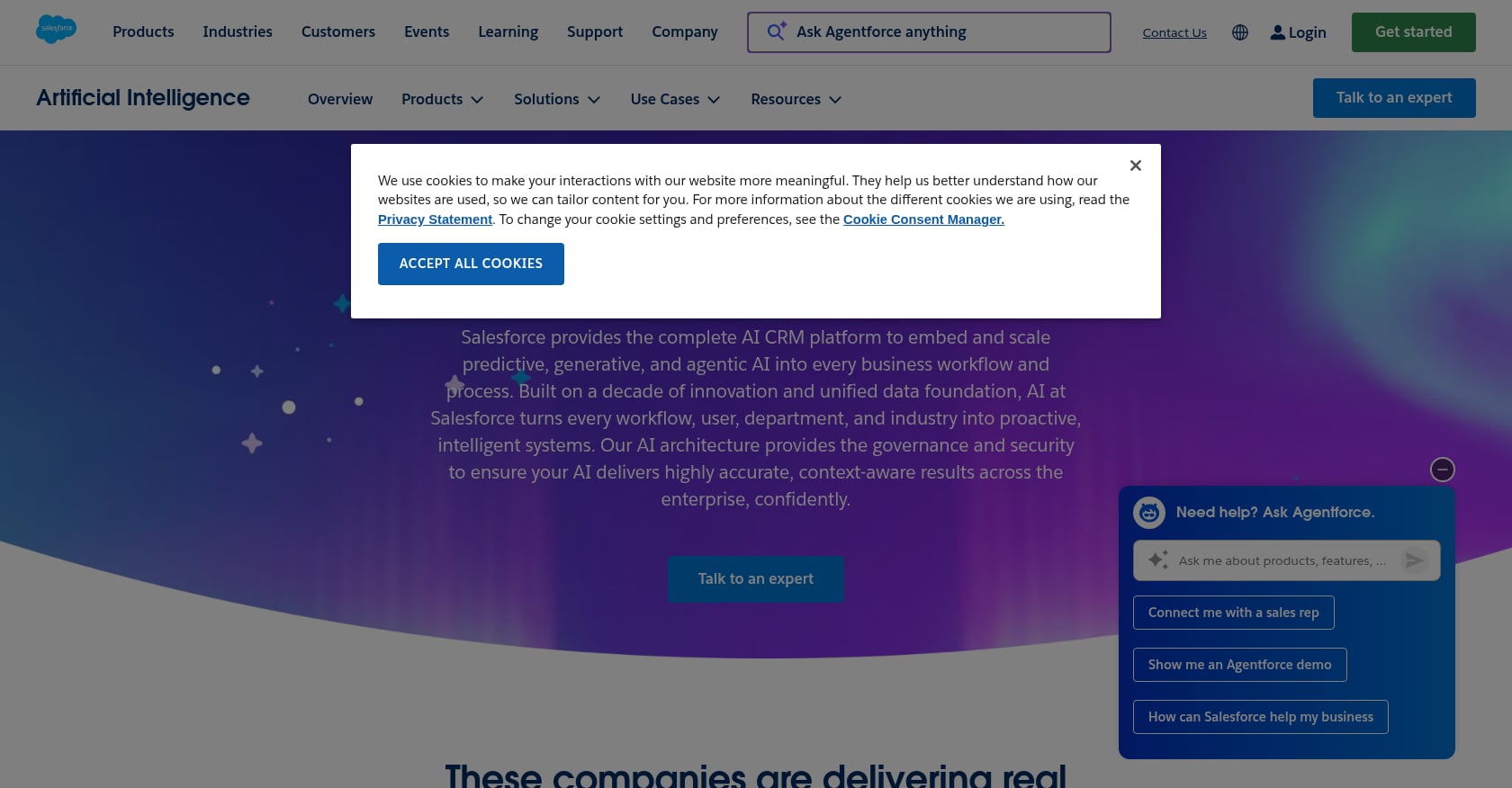
Best for: Enterprise organizations fully committed to Salesforce as their CRM, with high deal volumes that benefit from AI-prioritized pipeline review.
What it is: Salesforce Einstein GPT integrates generative AI into the Salesforce ecosystem to automate routine tasks, personalize customer interactions, and surface actionable insights across sales, marketing, and service functions.
Pricing:
- Sales GPT / Service GPT: $50 per user per month as an add-on
- Included in the “Unlimited” package at $330 per user per month
- Additional costs for Data Cloud and Marketing Cloud integrations
Key features:
- AI-generated email drafts pulled from CRM context and deal history
- Pipeline scoring and deal health predictions
- Automated call summaries and next-step recommendations
- Integration with Salesforce Marketing Cloud for campaign personalization
Tradeoffs:
- Enterprise-oriented pricing makes it impractical for startups or lean teams
- Requires deep Salesforce commitment. As multiple analysts note, the decision between Einstein and Microsoft Copilot is almost entirely determined by which CRM your team already uses.
- Implementation complexity is real. Expect weeks of setup, not hours.
6. Gong
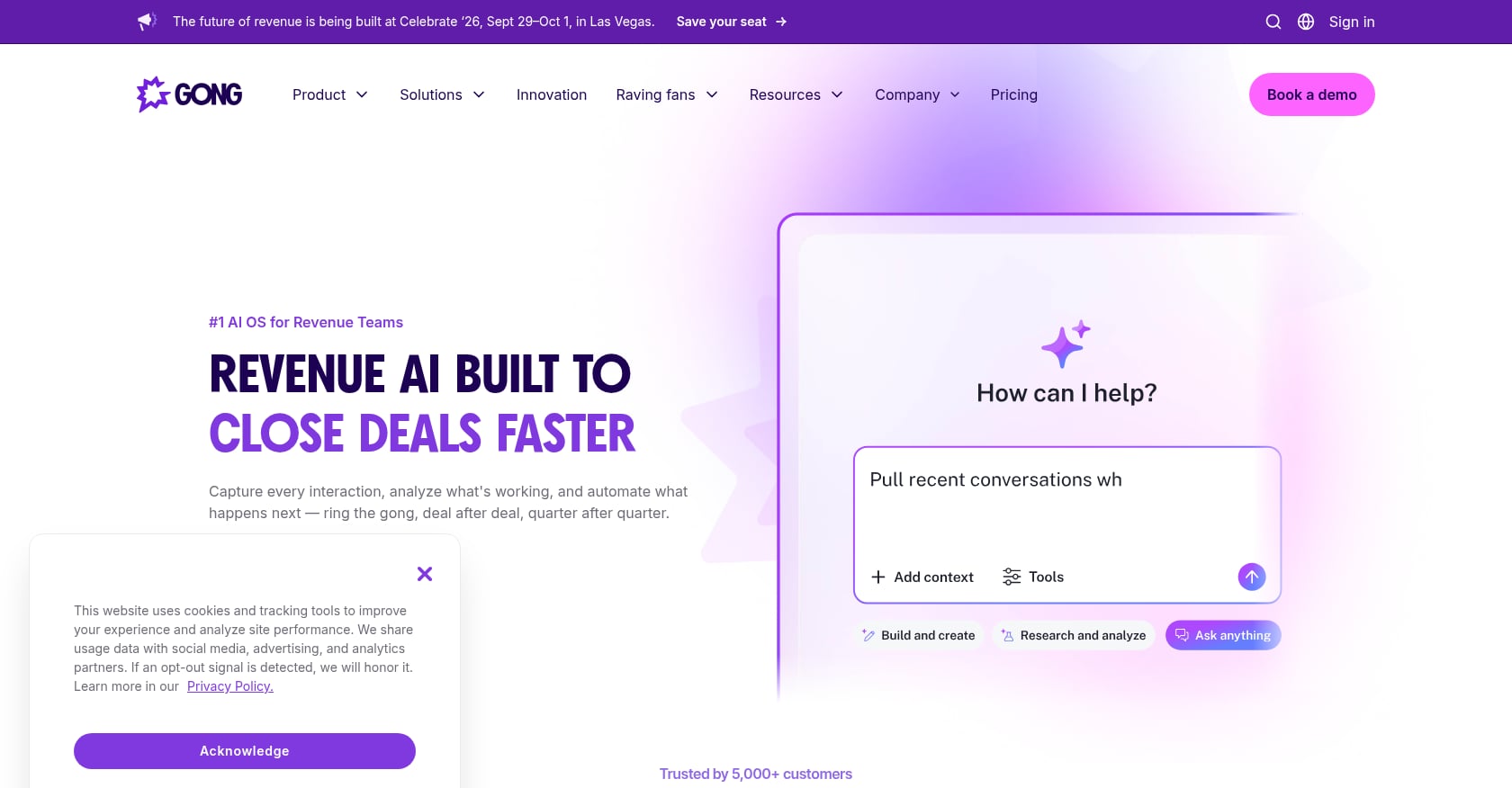
Best for: Revenue-aligned B2B organizations with 30+ sales reps where calls drive pipeline.
What it is: Gong is a revenue intelligence platform built around conversation analytics, deal health scoring, and forecasting. It records and analyzes sales calls, surfaces coaching insights, and helps leaders understand why deals are won or lost.
Pricing:
Gong pricing in 2026 runs $1,200 to $1,600 per seat per year, with a typical 15-seat minimum. That puts the contract floor at $18,000 to $24,000 per year. Historical customers report paying around $160 per user per month, while new 2025–2026 contracts quote $250 per user per month minimum because the sales team aggressively pushes bundles.
Key features:
- Call recording and transcription with AI-powered insights
- Deal health scoring and pipeline forecasting
- Coaching recommendations based on top-performer patterns
- Integration with major CRMs for automatic deal updates
Tradeoffs:
- Pricing is opaque. Features previously included in the base bundle were unbundled into paid modules, raising effective per-user costs 25–56% between 2023 and 2026.
- Overkill for startups or small teams. For teams under 30 reps, the common advice from practitioners is to evaluate Chorus, Fireflies.ai, tl;dv, or Avoma instead.
- Not a generative content tool. Gong analyzes conversations; it doesn’t create marketing assets.
For startups looking at sales automation tools at a more accessible price point, there are better starting points.
7. Clay
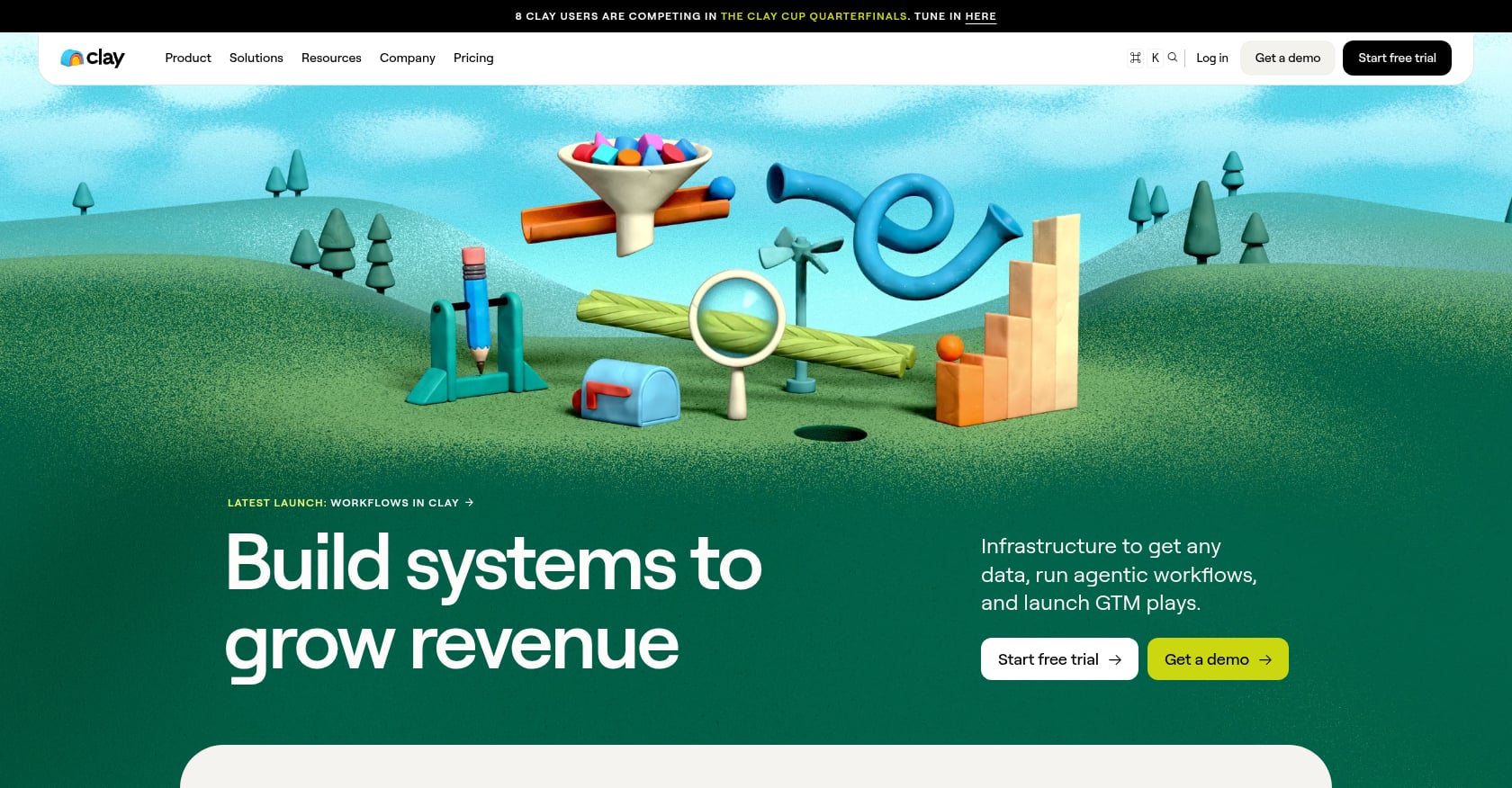
Best for: RevOps teams and growth marketers engineering data-heavy outbound motions.
What it is: Clay is exceptional at one thing: pulling and enriching data from multiple providers in a single workflow. It’s a data tool with workflow capabilities bolted on, not a full sales engagement platform.
Pricing:
- Free: 100 search credits/month
- Launch: $185/month
- Growth: $495/month
- Enterprise: custom
Key features:
- Multi-source data enrichment (pulls from 50+ data providers in one workflow)
- Waterfall enrichment that tries multiple sources automatically
- AI-powered research agents for company and contact intelligence
- Integrations with CRMs and outbound tools
Tradeoffs:
- 42% of negative Clay reviews mention credit burn. Users report spending $800 in a single week while learning the platform. The credit system penalizes experimentation.
- Clay is not a sending tool. You still need LinkedIn automation ($100–$200/month) and an email tool ($50–$150/month), putting your actual outbound stack cost at $500–$700/month.
- Steep learning curve. The interface is powerful but not intuitive for non-technical users.
User perspective: Practitioners on Reddit describe Clay as “spreadsheets on steroids” for people who enjoy building data workflows. If you want plug-and-play simplicity, look elsewhere. If you have a RevOps person who thinks in formulas and API calls, Clay is their playground. For teams building lead lists from scratch, it’s worth understanding Clay’s capabilities and costs before committing.
8. ChatGPT / Claude
Best for: Prompt-savvy solo operators and founders who want a cheap foundation layer for generative AI in sales and marketing.
What it is: General-purpose large language models from OpenAI and Anthropic. Marketing and sales teams use them for campaign copy, emails, social media posts, blog drafts, keyword research brainstorming, audience segmentation ideas, and sales message variations.
Pricing:
- ChatGPT Plus: $20/month
- ChatGPT Team: $25/user/month
- Claude Pro: $20/month
Key features:
- Broadest range of capabilities across any single tool
- Custom GPTs / Projects for repeatable marketing workflows
- Image generation (ChatGPT) and long-context analysis (Claude)
- Canvas/Artifacts for collaborative document editing
Tradeoffs:
- No workflow orchestration, CRM integration, or GTM automation
- No brand voice guardrails unless you manually prompt them every time
- Outputs require significant editing for brand consistency
- No built-in collaboration features for team review and approval
The honest assessment: ChatGPT and Claude are the cheapest entry point into generative AI for sales and marketing, and also the most manual. They’re the right starting point if you’re testing whether AI content works for your audience. They’re the wrong long-term solution if you need consistent, multi-channel output at any real volume.
9. Lavender
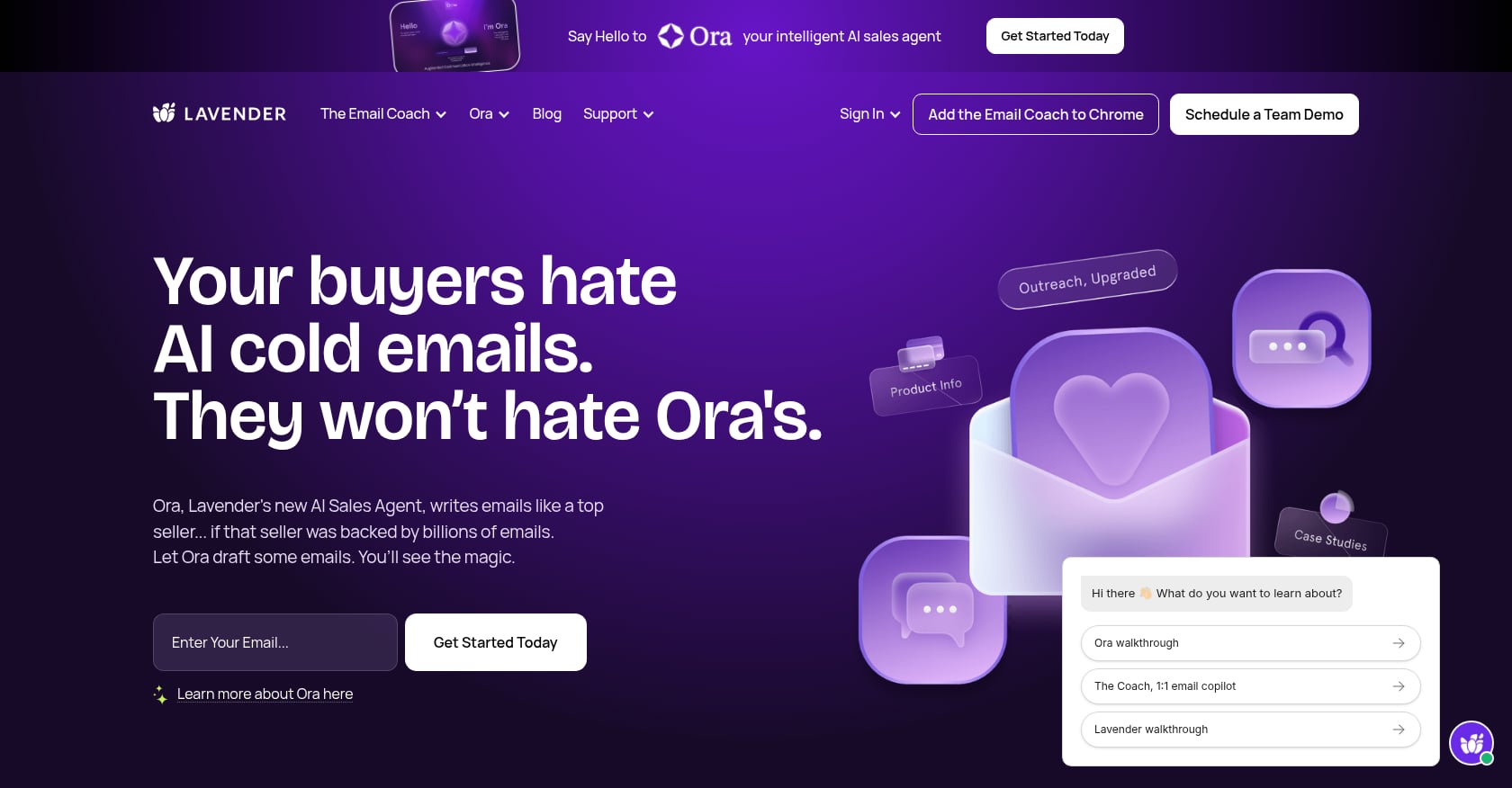
Best for: SDR teams focused on improving cold email reply rates through real-time coaching.
What it is: Lavender analyzes outbound emails before they’re sent, providing real-time guidance on clarity, tone, length, and structure. It scores each email and suggests specific improvements to increase the likelihood of a reply.
Pricing:
- Free: limited email analyses
- Starter: $29/month
- Individual Pro: $49/month
- Team: custom pricing
Key features:
- Real-time email scoring and coaching suggestions
- Personalization assistant that pulls prospect data into recommendations
- Team analytics showing coaching impact on reply rates
- Integration with Gmail, Outlook, and major sales engagement platforms
Tradeoffs:
- Narrow scope. Lavender does email coaching and nothing else.
- Limited value for teams where email isn’t the primary outbound channel
- Doesn’t generate emails from scratch; it improves what you’ve already written
For teams looking to improve their outbound sequences more broadly, this guide on outbound email best practices covers the strategic layer that Lavender doesn’t address.
10. Hootsuite AI
Best for: Social-first marketing teams that need scheduling, analytics, and content generation in one place.
What it is: Hootsuite’s AI features help marketers understand audience engagement patterns, optimize posting schedules, and generate content ideas across social platforms.
Pricing:
- Professional: $99/month (1 user, 10 social accounts)
- Team: $249/month (3 users)
- Enterprise: custom
Key features:
- AI-powered post generation and caption writing
- Best-time-to-post recommendations based on audience data
- Social listening and sentiment analysis
- Unified inbox for cross-platform engagement
Tradeoffs:
- Weak on sales use cases. Hootsuite is a marketing tool, not a revenue tool.
- AI content suggestions are serviceable but not exceptional; they won’t replace a skilled social media writer.
- Pricing has crept up significantly. The free plan was eliminated, and the entry point is now $99/month.
How to Choose: A Decision Framework
Picking the right generative AI tools for sales and marketing depends on three variables: team size, monthly budget, and primary GTM channel.
If you’re a solo founder with no marketing hires: Start with ChatGPT ($20/month) for content drafts and Lavender ($29/month) for email coaching. Total: under $50/month. When you’re ready to scale beyond manual workflows, consider an AI marketing agent for startups that handles execution, not just content generation.
If you’re a startup team of 2–5 with a $500–$1,000/month tool budget: An agentic execution model like AgentWeb ($199/month DIY) gives you campaign shipping across channels without assembling a Frankenstein stack. Add Lavender for email coaching if outbound is a major channel.
If you have a marketing team of 5+ and a $2,000+/month budget: Stack Jasper for content consistency, your CRM’s native AI (Breeze or Einstein), and Clay for enrichment if you’re running outbound. The coordination overhead of multiple tools is manageable at this team size.
If you’re an enterprise sales org with 30+ reps: Gong for conversation intelligence, Salesforce Einstein for pipeline scoring, and Clay for enrichment. Budget accordingly: you’re looking at $50K+/year.
For a deeper comparison of DIY AI tools versus agentic execution, the tradeoffs between assembling your own stack and using an integrated system are worth understanding before you commit.
Common Mistakes to Avoid
Buying six tools when you need one system. The average startup marketing stack now includes 5–8 AI subscriptions. Each one does something well in isolation. None of them talk to each other. Before adding another tool, ask whether your real problem is capability or coordination.
Ignoring human oversight. According to Gartner, 73% of marketing leaders say generative AI hallucinations are a concern for their organization. Statista’s 2026 Content Marketing Trend Study found that marketers don’t trust AI with final quality approval or ethical, legal, and compliance assessments. Human-in-the-loop isn’t a weakness. It’s the missing ingredient in most AI marketing stacks.
Not tracking AI-specific KPIs. Only 19% of content marketers track AI-specific performance metrics. If you can’t measure whether AI is improving your output quality, speed, or conversion rates, you can’t make informed decisions about which tools to keep and which to cut.
Choosing enterprise tools on a startup budget. Gong’s $18K+/year minimum and Salesforce Einstein’s per-user pricing make sense at scale. For a 3-person startup, they’re budget killers that deliver capabilities you won’t fully use for years.
Every dollar invested in generative AI returns an average of $3.70, and companies report productivity improvements of 15–30%. But those returns only materialize when the tools match the team.
Try AgentWeb’s 7-day free trial to see how agentic execution compares to managing a stack of point tools.
FAQ
What is generative AI for sales and marketing?
Generative AI for sales and marketing refers to artificial intelligence systems that create new content (emails, ad copy, blog posts, images, video scripts) and automate multi-step workflows across the revenue funnel. Unlike predictive AI, which analyzes existing data to forecast outcomes, generative AI produces original outputs. In practice, most modern tools blend both capabilities.
How much do generative AI marketing tools cost?
Costs range dramatically. ChatGPT Plus starts at $20/month for individuals. Mid-tier platforms like Jasper and Copy.ai run $49–$249/month. CRM-native solutions like HubSpot Breeze and Salesforce Einstein add $50–$4,700+/month depending on usage. Enterprise tools like Gong start at $18,000/year. The real cost often exceeds sticker price once you account for add-ons, per-seat scaling, and credit systems.
Can generative AI replace a marketing team?
Not yet, and likely not anytime soon. AI handles execution speed and volume well, particularly for content drafts, data enrichment, and email personalization. But strategy, brand judgment, compliance review, and creative direction still require humans. The most effective model in 2026 is a hybrid: AI handles the repetitive work, humans steer decisions and approvals.
What’s the ROI of AI in sales?
McKinsey research shows companies investing in AI see revenue uplift of 3–15% and sales ROI improvements of 10–20%. AI-driven campaigns deliver 22% better ROI than traditional campaigns on average. Sales reps save approximately 11.5 hours weekly on research tasks when using AI-powered tools. The key is measuring these gains against your actual tool costs, not just the headline statistics.
What’s the difference between an AI writing tool and an agentic AI platform?
An AI writing tool (Jasper, Copy.ai, ChatGPT) generates content when prompted. An agentic AI platform goes further: it autonomously executes multi-step workflows like researching prospects, creating campaign assets, distributing them across channels, and reporting on performance. The agent acts on your behalf within guardrails you set, rather than waiting for prompt-by-prompt instructions.
How do I avoid tool sprawl with generative AI?
Start by mapping your actual workflow, not your wish list. Identify the three or four activities that consume the most time (usually content creation, prospect research, email writing, and reporting). Choose one platform that covers at least two of those. Only add point solutions for gaps the primary platform can’t fill. Revisit quarterly and cut what isn’t driving measurable results.
Is generative AI safe to use for customer-facing content?
With proper guardrails, yes. The risks are real though: 56% of marketers report concerns about hallucinations, and 70% worry about customer data privacy with generative AI. Mitigate these by implementing human review before anything goes live, using brand voice controls where available, and never feeding sensitive customer data into tools without understanding their data retention policies.
Or get a free AI Readiness Roadmap to see where your GTM has gaps.
Ex-Meta, Google, LinkedIn. 10+ years in ML & data science for GTM. Expert in customer acquisition and growth activation.
Get a free Stack Review.
30 min with Harsha and Matt.
We audit your last 30 days, pinpoint the highest-impact fixes, and hand you the exact playbook we'd run. No deck. No pitch unless there's a fit.