Best Marketing Operations Software (2026): 9 Top Picks


TL;DR
Marketing operations software is the control layer between your strategy and actual execution. The category spans work management, campaign automation, and analytics, but most teams don’t need all three from separate vendors. This guide compares 9 platforms by price, team size fit, and honest tradeoffs. Startups with lean teams should focus on systems that ship campaigns from Day 1 rather than assembling a patchwork of enterprise tools. AgentWeb is the top pick for early-stage teams that need full go-to-market execution without hiring a marketing department.
Explore AgentWeb’s AI marketing automation to see how it works for startups.
What Marketing Operations Software Actually Does
Marketing operations software has become a confusing term. It covers everything from project management boards to full campaign automation suites. Forrester recently formalized the category as MOMS (Marketing Operations Management Solutions), defining it as technology that helps marketers manage financial planning, project workflows, content production, asset management, and performance analytics.
That’s a wide net. In practice, marketing operations software falls into three buckets:
Work management tools handle people, processes, and budgets. Think Monday.com, Asana, and Workamajig. They’re about who does what by when.
Campaign automation platforms deploy and run actual marketing. HubSpot, Marketo, Brevo, and Salesforce Marketing Cloud live here. They send emails, trigger workflows, and manage contacts.
Analytics and reporting tools track what happened and why. Some platforms bake this in, others require standalone BI tools.
Forrester’s Q1 2026 Landscape report evaluated 24 vendors in the MOMS space, noting significant variation by company size, geography, and use case. The market remains fragmented. Today’s marketers buy piecemeal tools based on individual use cases, and the resulting stack often creates more problems than it solves.
That fragmentation is the core pain point this article addresses. The goal isn’t finding the tool with the longest feature list. It’s finding the system that replaces chaos with consistent execution.
How We Evaluated These Tools
Every tool in this list was assessed against five criteria:
- Pricing transparency. Does the vendor publish real numbers, or do you need a sales call to learn the cost?
- Channel coverage. Can it handle email, social, paid ads, SEO, or just one channel?
- AI capabilities. Does the AI actually execute tasks, or just make suggestions you still have to act on?
- Ease of use for small teams. Can a 3-person startup use this without a dedicated ops hire?
- Scalability. Will it grow with you from seed stage to Series B and beyond?
Beyond vendor materials, we drew on practitioner discussions from Reddit communities (r/marketing, r/smallbusiness, r/entrepreneur), G2 reviews, and Forrester’s 2026 market analysis. Community sentiment matters because it captures what marketing software actually feels like in daily use, not what the sales page promises.
Quick Comparison Table
| Tool | Starting Price | Best For | Pricing Model | Free Tier | AI Features |
|---|---|---|---|---|---|
| AgentWeb | $199/mo | Startups needing full GTM execution | Flat monthly | 7-day trial | Emma AI agent |
| HubSpot Marketing Hub | $20/seat/mo | Growing SMBs wanting CRM + marketing | Per-seat + per-contact | Yes (limited) | Breeze AI |
| Monday.com | $9/seat/mo (3-seat min) | Marketing project management | Per-seat | Yes (2 seats) | AI credits (add-on) |
| Brevo | $9/mo (5K emails) | Budget multi-channel email | Per-email volume | Yes (300/day) | Brevo AI |
| CoSchedule | $39/user/mo | Content calendar + social scheduling | Per-user | Yes (limited) | Hire Mia AI |
| Airtable | Free (limited) | Custom no-code marketing workflows | Per-seat | Yes | Airtable AI |
| Workamajig | Quote-based | Creative agencies | Custom | No | Limited |
| Adobe Marketo Engage | ~$895/mo est. | Enterprise B2B with MOps teams | Quote-based | No | Adobe AI |
| Salesforce Marketing Cloud | $25/user/mo (Starter) | Enterprise Salesforce shops | Per-org or per-user | No | Einstein AI |
The 9 Best Marketing Operations Software Platforms
Tools are ordered from most startup-accessible to most enterprise-focused.
1. AgentWeb
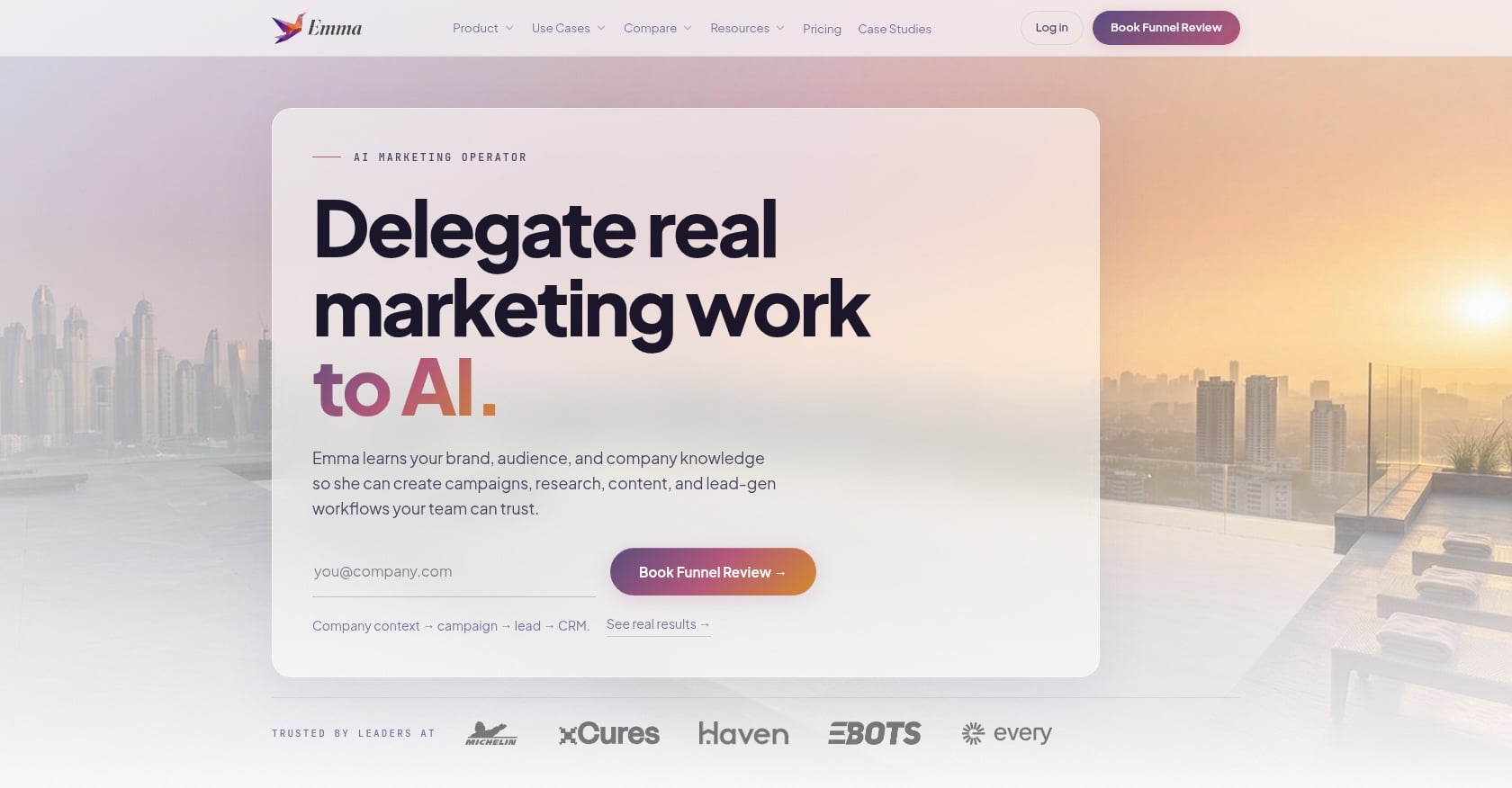
Best for: Early-stage startups (pre-seed to Series A) that need end-to-end marketing execution without hiring a full team.
Pricing: Self-serve platform at $199/month with a 7-day free trial. Done-for-you and co-pilot tiers are available seasonally through the sales team.
AgentWeb takes a fundamentally different approach to marketing operations. Instead of giving you a platform to configure, it gives you a system that ships. The AI agent “Emma” combines with senior human operators to execute across paid, organic, email, and SEO starting from Day 0. A Week-0 diagnostic produces a 90-day GTM plan, then the system executes weekly with Slack or Teams approvals and a dedicated portal.
Key features:
- 90-day GTM diagnostic and execution plan from the first week
- Multi-channel campaign execution (Meta, Google, LinkedIn/X, email, outbound)
- Slack/Teams workflow approvals for speed without losing control
- Founder-brand support including LinkedIn ghostwriting
- Weekly performance reviews with budget reallocation
- Portal with calendars, dashboards, and optimization loops
Proof: Case studies show 4,000+ leads and 328 add-to-carts in 3 months for a consumer brand, and 13.19% CTR peak on a $300/month ad budget in digital health. You can see real case studies for full details.
Tradeoffs:
- Newer brand with limited third-party reviews compared to established platforms
- Best experience requires weekly Slack/Teams engagement and approvals
- Self-serve tier currently emphasizes content and SEO over paid media
Who should pick this: If you’re a founder or solo marketer drowning in tools that don’t talk to each other, AgentWeb is built for exactly that problem. It’s not another point tool to configure. It’s an execution system.
Compare AgentWeb plans and pricing to find the right tier.
2. HubSpot Marketing Hub
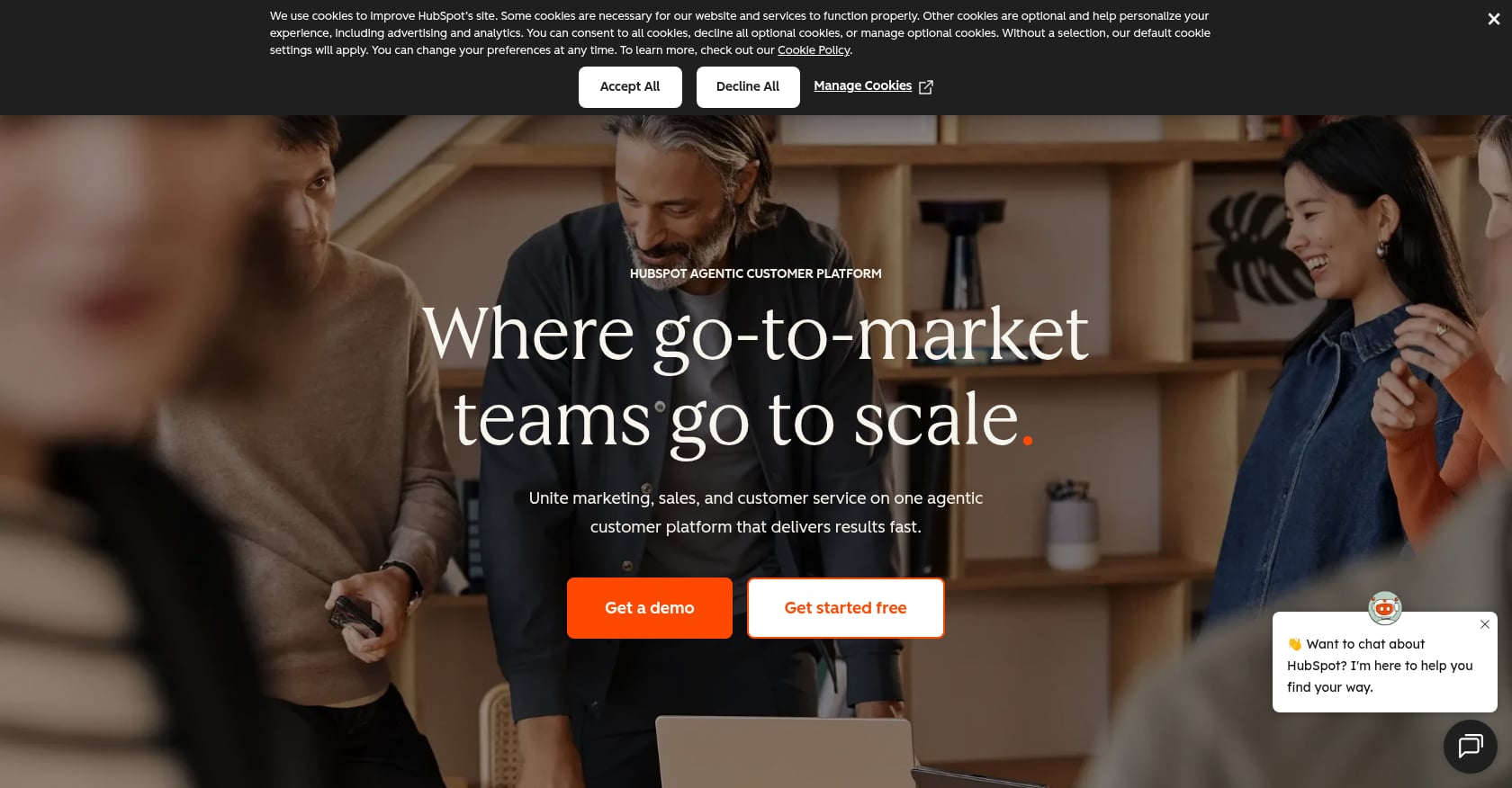
Best for: Growing SMBs that want CRM and marketing in one system.
Pricing: Free ($0), Starter ($20/seat/month annual), Professional ($890/month annual, 3 seats included), Enterprise ($3,600/month annual, 5 seats included).
HubSpot is the default recommendation for mid-market teams, and for good reason. The ecosystem is enormous, the learning resources are excellent, and the free tier is generous enough to test before committing.
Key features:
- All-in-one CRM, email marketing, landing pages, and automation
- Breeze AI for content suggestions and workflow optimization
- Extensive app marketplace with 1,500+ integrations
- Built-in reporting dashboards
The hidden cost you need to know about: The $3,000 onboarding fee is mandatory and non-refundable for Professional tier. You pay it whether or not you use onboarding services. This is the most commonly cited pricing surprise in HubSpot reviews.
The Starter-to-Professional pricing cliff is brutal. You jump from roughly $20/seat/month to $890/month. Practitioners on Reddit consistently flag this as a make-or-break decision point for growing teams. It’s the single biggest price jump in mainstream marketing software, and it catches many companies off guard during budget planning.
Tradeoffs:
- Contact-based overage costs can escalate quickly as lists grow
- Marketing automation is gated behind the Professional tier
- The onboarding fee adds significant upfront cost
User sentiment: Widely praised for ease of use. The biggest complaints center on surprise costs and the feeling of being locked into an increasingly expensive ecosystem.
3. Monday.com
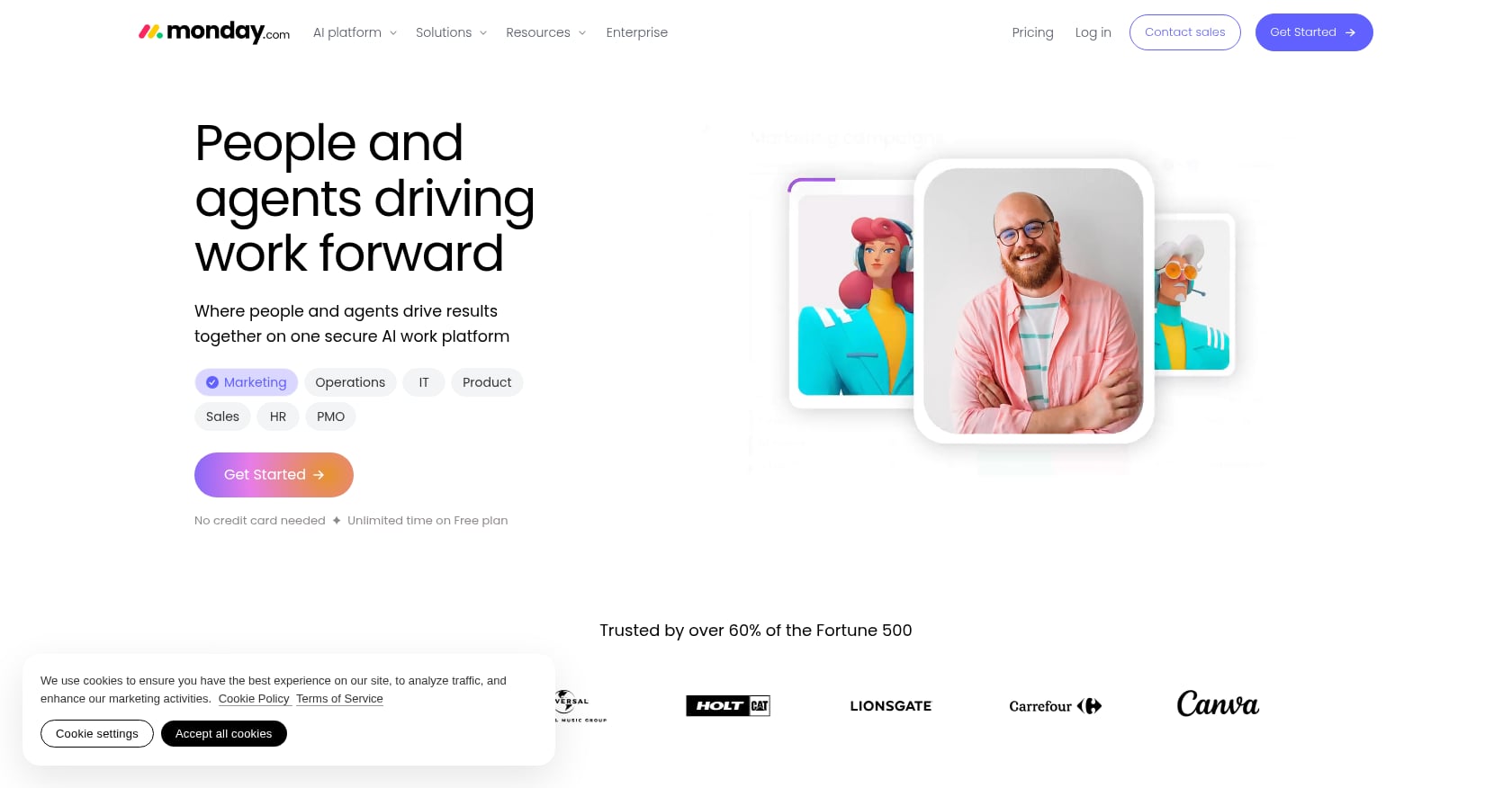
Best for: Marketing teams that need visual project management and campaign tracking.
Pricing: Basic ($9/seat/month), Standard ($12/seat/month), Pro ($19/seat/month), all billed annually. All paid plans require a minimum of 3 seats.
Monday.com is a work management tool first, marketing operations platform second. It excels at organizing who’s doing what, tracking campaign timelines, and giving leadership visibility into marketing output.
Key features:
- Visual, highly customizable boards and workflows
- 200+ native integrations including Salesforce, HubSpot, Adobe Creative Cloud, and Slack
- Open API for custom connections
- Monday Marketer add-on for campaign-specific workflows
Tradeoffs:
- No native email sending, marketing automation, or campaign execution
- AI credits are sold separately as an add-on
- Most teams need the Standard plan at minimum, since Basic lacks the features that make Monday.com worth using
- Needs to be paired with other tools for end-to-end marketing operations
User sentiment: Practitioners love the visual interface and flexibility. But the common frustration is that Monday.com organizes your marketing work without actually doing any of it. You still need separate tools for execution.
4. Brevo (formerly Sendinblue)
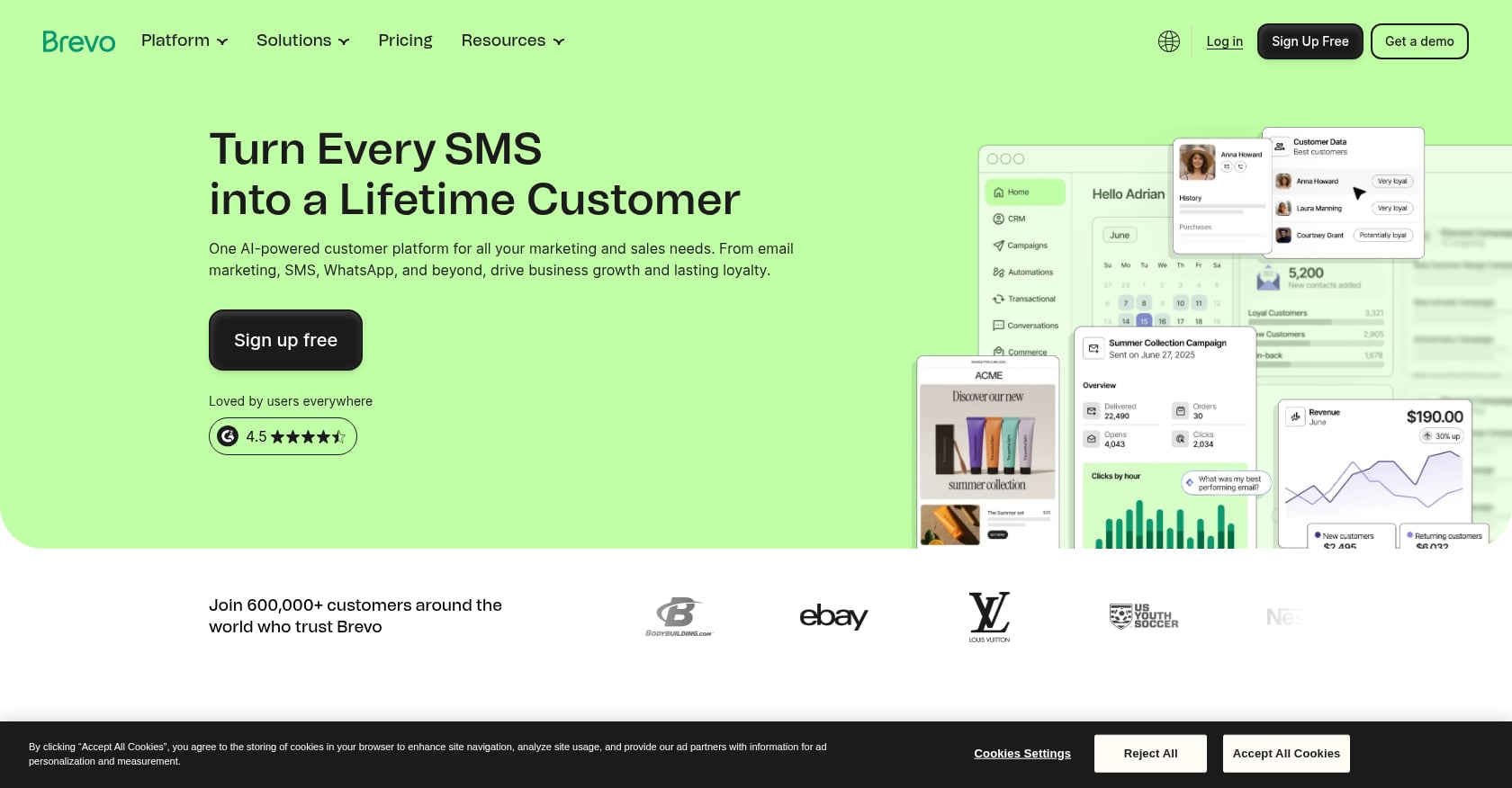
Best for: Budget-conscious teams that need email and multi-channel marketing without per-contact pricing.
Pricing: Free (300 emails/day), Starter ($9/month), Standard ($18/month), Professional ($499/month). Pricing scales by email volume, not contacts stored.
Brevo’s pricing model is its biggest advantage. While HubSpot and others charge per contact (punishing you for growing your list), Brevo charges per email sent. For businesses with large contact lists that send infrequently, this can mean savings of hundreds or thousands per month.
Key features:
- Email, SMS, and WhatsApp campaigns in one platform
- Marketing automation workflows (starting at Standard tier)
- Transactional email API
- CRM with deal pipeline tracking
Tradeoffs:
- Marketing automation is excluded from Free and all Starter plans, starting only at Standard ($18/month, realistically $69/month at the 20K-email tier)
- Email deliverability gets mixed reviews compared to dedicated platforms
- SMS and WhatsApp are billed separately, which surprises multi-channel senders
- Customer support is sometimes slow according to user reviews
User sentiment: The pay-per-email model is repeatedly praised on review sites as a standout advantage. One common thread across forums: Brevo is the best option for teams that own a large database but run lean on sending frequency.
5. CoSchedule Marketing Suite
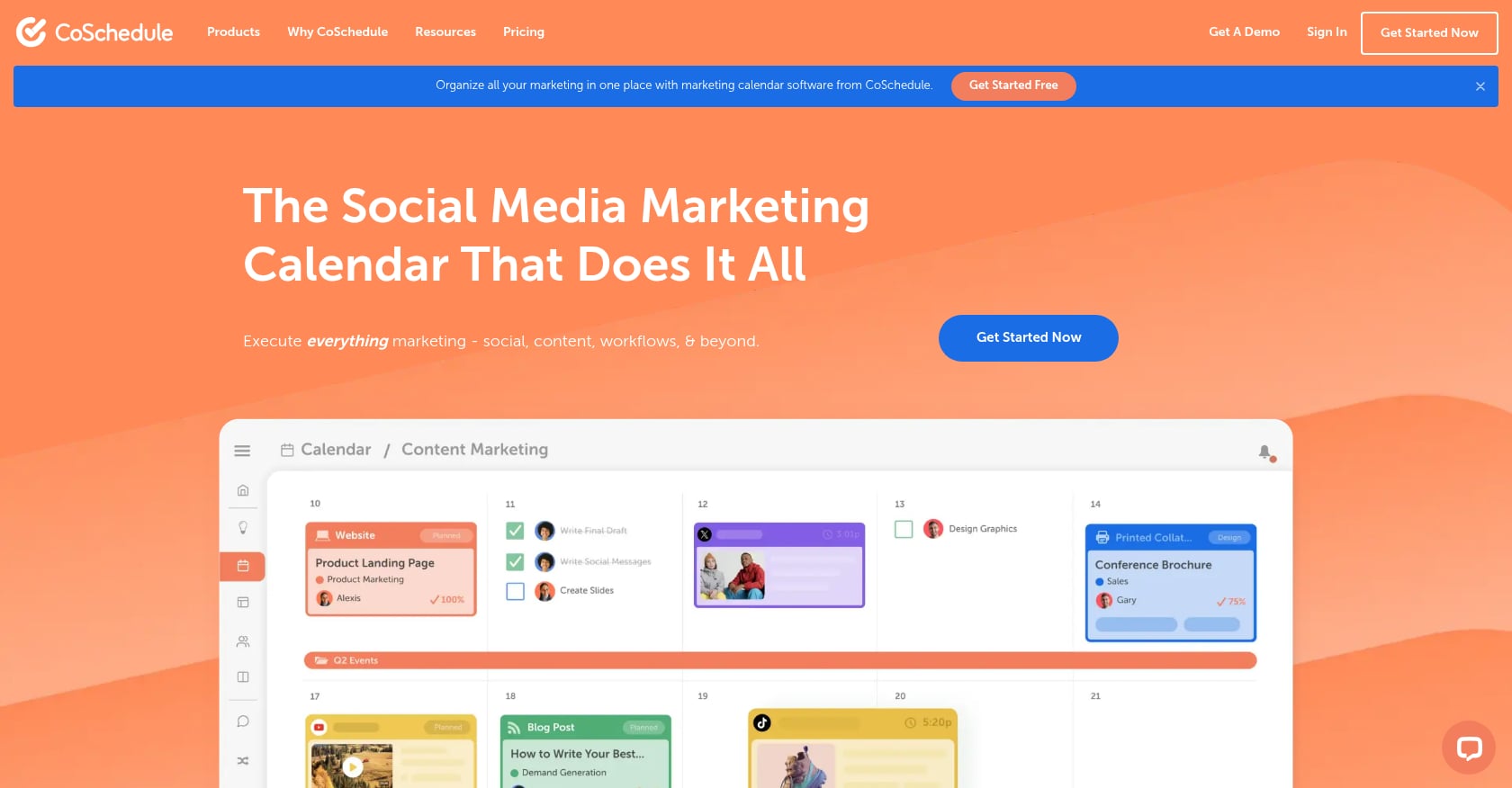
Best for: Content-driven teams needing an editorial and social calendar with built-in scheduling.
Pricing: Pro plan at $39/user/month. Free version and free trial available (no credit card required).
CoSchedule is the content marketing team’s favorite calendar. Its signature feature, ReQueue, automatically fills gaps in your social media schedule by re-sharing your best evergreen content. For teams that struggle with consistent posting, this alone can justify the price.
Key features:
- Unified marketing calendar for content, social, and campaigns
- ReQueue intelligent social media recycling
- Hire Mia AI assistant for content ideation and drafts
- Team workflow and approval management
For teams focused on building a repeatable publishing system, a strong content operations workflow matters more than any single tool.
Tradeoffs:
- No email automation, paid ads management, or CRM functionality
- Interface can feel overwhelming due to feature density
- Pricing is higher than some social-only scheduling alternatives
- Analytics are basic compared to dedicated reporting tools
User sentiment: Users report genuine value in the calendar and scheduling features but note the platform is more of a content ops layer than a complete marketing operations solution.
6. Airtable
Best for: Teams that want a flexible, no-code platform to build custom marketing workflows.
Pricing: Free tier available (limited records and features). Paid plans scale per seat.
Airtable is a platform, not a solution. That distinction matters. It won’t send your emails or run your ads, but it can become the connective tissue that holds your marketing operations together if you’re willing to build.
Key features:
- Interface Designer for custom stakeholder dashboards
- Airtable AI for content generation, feedback summarization, and auto-tagging
- Extensive automation triggers and actions
- API access for deep integrations
Tradeoffs:
- Requires significant configuration before it’s useful for marketing ops
- No native campaign execution, email sending, or ad management
- Can become complex and hard to maintain as workflows grow
- The “blank canvas” problem: powerful but paralyzing for teams that need direction
User sentiment: Airtable is beloved by operations-minded marketers who enjoy building systems. But for founders or solo marketers who just need campaigns to ship, the configuration overhead is a real barrier.
7. Workamajig
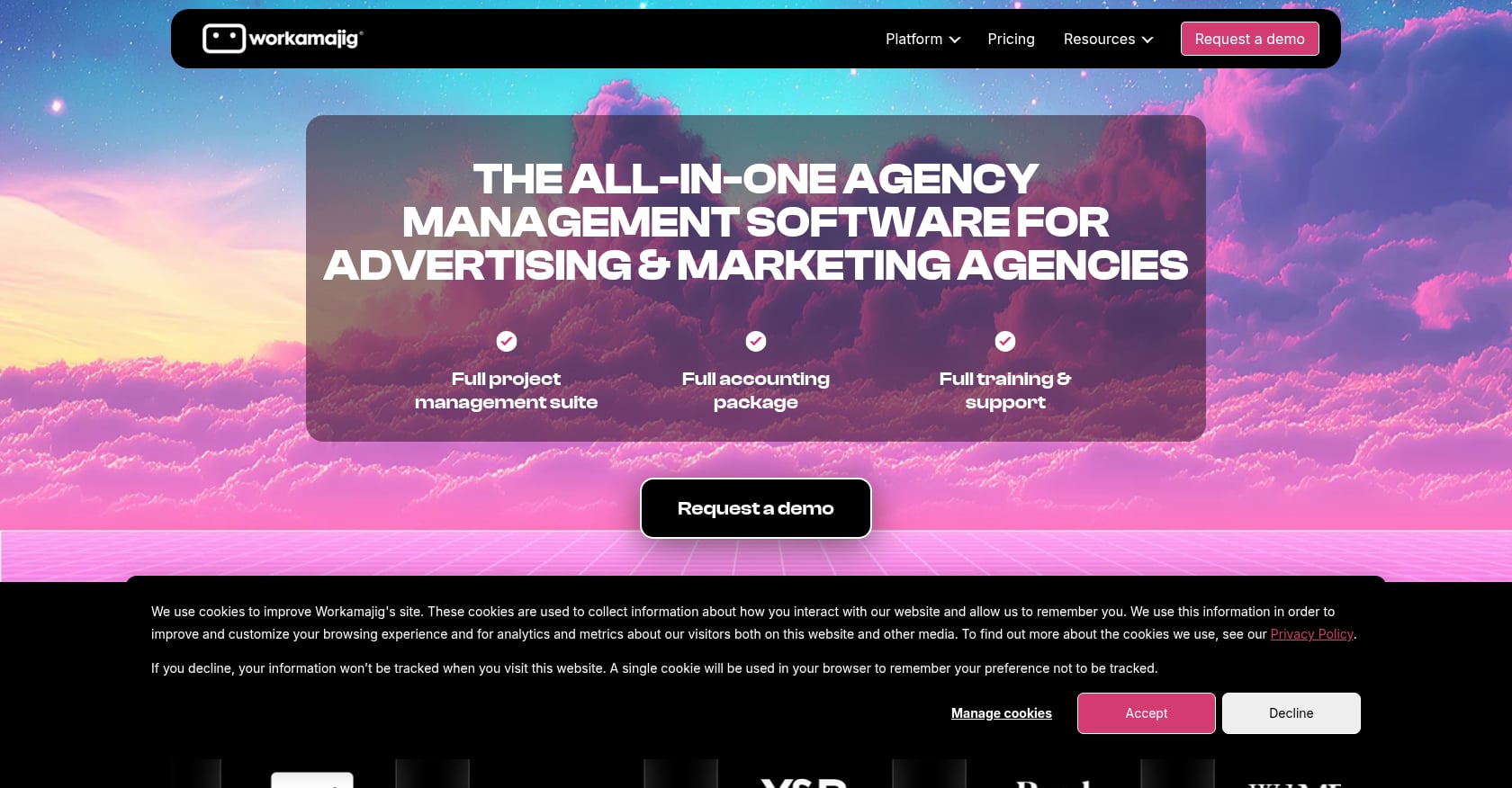
Best for: Creative agencies managing client work, resources, and finances in one system.
Pricing: Custom, demo-based. Positioned for agencies rather than in-house marketing teams.
Workamajig is the only tool on this list built specifically for agencies. It combines project management, resource scheduling, staff utilization tracking, budgeting, expense tracking, and invoicing into a single platform.
Key features:
- Project and campaign management with detailed planning
- Resource scheduling including freelancer management
- Financial tracking with profitability analysis
- Client-facing estimates and invoices
Tradeoffs:
- Agency-specific, overkill for startups or in-house teams
- No marketing automation or campaign execution capabilities
- Steeper learning curve due to financial management complexity
- Limited value for teams not billing clients for marketing work
8. Adobe Marketo Engage
Best for: Enterprise B2B teams with 25K+ contacts and dedicated marketing operations staff.
Pricing: Adobe does not publish list prices. All editions (Growth, Select, Prime, Ultimate) are quote-based. Third-party estimates range from roughly $895 to $3,195/month, but these are unofficial.
Marketo is the heavyweight of B2B marketing automation. Its lead scoring, nurturing workflows, and account-based marketing capabilities are among the most sophisticated available. It’s also among the most complex.
Key features:
- Advanced lead scoring and nurturing workflows
- Account-based marketing tools
- Multi-touch revenue attribution
- Adobe ecosystem integration (Experience Cloud, Analytics)
Tradeoffs:
- Steep learning curve that typically requires a dedicated MOps hire
- Reporting is weak enough that many teams rely on third-party tools
- Opaque pricing requires a sales conversation
- Implementation timelines measured in months, not days
User sentiment: G2 reviewers consistently praise the automation depth while noting the learning curve is punishing. The general community consensus: if your organization has 25,000+ contacts, a $1M+ marketing budget, and a dedicated MOps team, Marketo justifies its price. If any of those conditions aren’t met, look elsewhere.
9. Salesforce Marketing Cloud
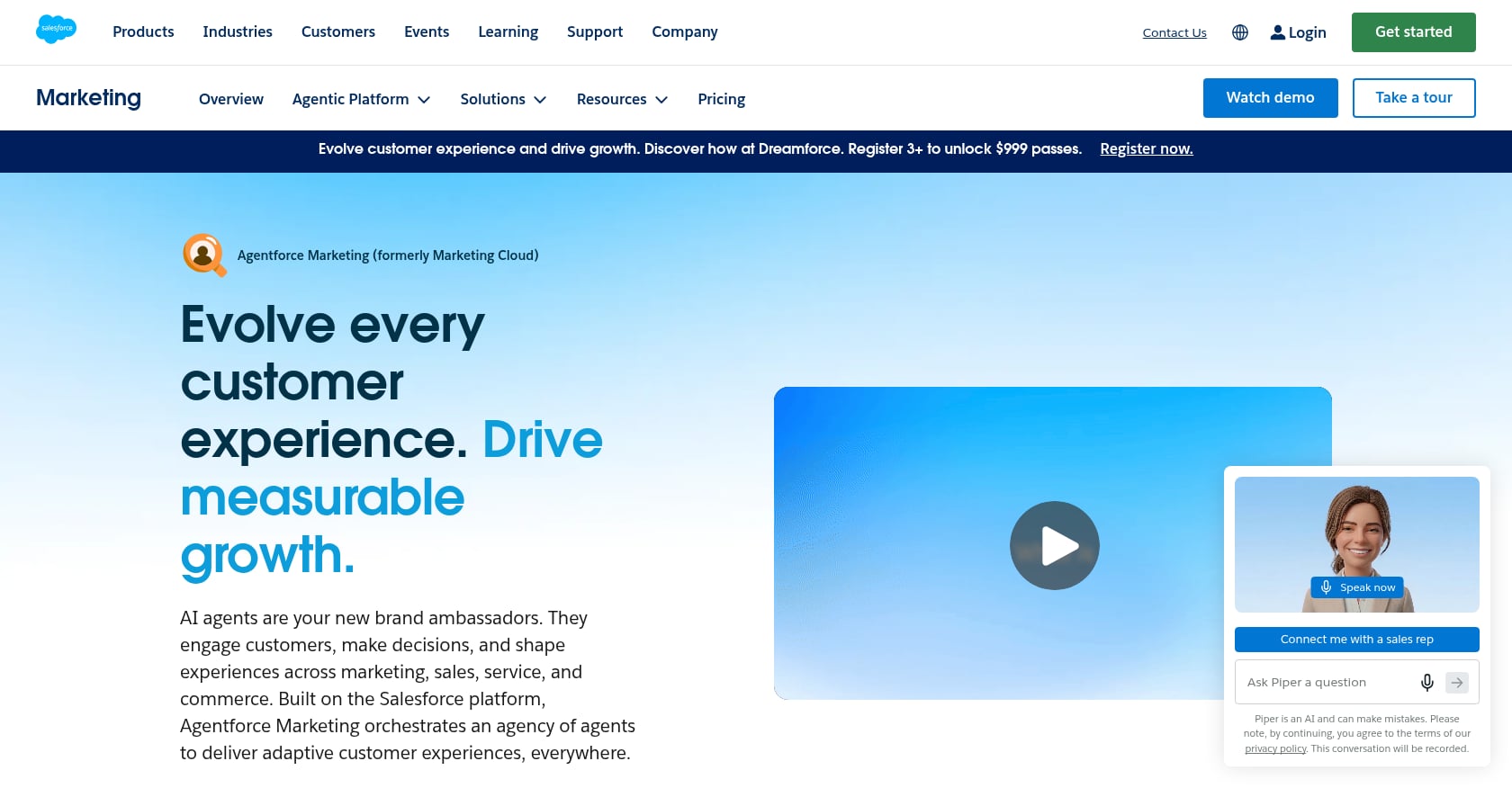
Best for: Large enterprises already invested in the Salesforce ecosystem.
Pricing: Starter Suite at $25/user/month, Growth Edition at $1,500/month, Advanced Edition at $3,250/month. Implementation costs can range from $10,000 to $50,000+ for customization.
Salesforce Marketing Cloud is the most powerful and most complex option on this list. It’s the right choice for companies with existing Salesforce CRM deployments that need deep data integration across sales and marketing.
Key features:
- Journey Builder for multi-step, cross-channel campaign automation
- Einstein AI for predictive analytics and personalization
- Deep CRM integration with Salesforce Sales Cloud
- Advanced segmentation and paid ads management capabilities
Tradeoffs:
- Extremely complex, requires certified administrators
- Small businesses consistently cite cost as prohibitive
- Additional functionalities and customizations add significant expense
- Not appropriate for startups by any reasonable measure
User sentiment: Praised for extensive features and potential ROI by enterprise users. But many reviewers find the total cost of ownership, once you factor in implementation, customization, and ongoing admin, far exceeds the sticker price.
Why Most Startups Don’t Need Enterprise Marketing Ops Tools
A RevOps consultant who analyzed hundreds of Reddit threads across r/smallbusiness, r/entrepreneur, and r/marketing found a clear pattern: business owners are drowning in tools, confused about where to start, and frustrated. The key takeaway was blunt: “Most businesses fail not because they lack tools, but because they have too many of the wrong ones.”
This matches what founders say directly. A common complaint from lean marketing teams: founders and marketers spend more time switching tabs and copying data than actually building momentum. The problem isn’t the lack of AI. It’s that the tools don’t talk to each other.
Redditors in marketing communities consistently repeat one piece of advice: “Master ONE automation before adding another.” This is the right instinct. A 3-person startup signing up for Marketo, Monday.com, and a separate analytics platform will spend more time managing the stack than running campaigns.
Forrester’s Budget Planning Survey shows marketing leaders heading into 2026 with cautious optimism, expecting modest budget growth. That means every dollar needs to work harder. The question for lean teams isn’t “which enterprise platform should we adopt?” It’s “what system can start producing results this week?”
For startups specifically, the answer is usually a platform that combines strategy, execution, and reporting into a single engagement rather than requiring assembly. If you’re trying to run launch campaigns without a full team, the last thing you need is three separate logins and a Zapier account to connect them.
How to Choose the Right Marketing Operations Software
The right marketing operations software depends on three variables: team size, budget, and how much you want to build versus buy.
Teams of 1 to 5 people (pre-seed to seed):
You don’t have time to configure platforms. You need a system that ships from Day 1. AgentWeb’s combination of AI execution and human operators fits here because it produces campaigns, not just capabilities. Brevo works as a budget email tool if email is your primary channel.
Build your marketing workflows with AgentWeb’s self-serve platform.
Teams of 5 to 20 people (Series A to B):
HubSpot Professional becomes viable at this stage if you can absorb the pricing cliff. Monday.com adds value for coordinating work across a growing team. CoSchedule makes sense if content is your primary growth lever.
Teams of 20+ people (growth stage and enterprise):
Marketo and Salesforce Marketing Cloud earn their complexity at this scale. You’ll have dedicated marketing ops staff to manage them, and the depth of automation and attribution justifies the investment.
The build-versus-buy decision:
Airtable represents the “build” path: maximum flexibility, maximum configuration. AgentWeb represents the “buy a running system” path. Most startups are better served by the latter. You can always add complexity later, but you can’t get back the months spent configuring a system instead of acquiring customers.
For a deeper look at whether assembling your own AI tools or using a managed system makes more sense, compare AgentWeb vs. DIY AI approaches side by side.
One more thing about AI:
Every tool on this list now has AI features. That’s table stakes in 2026. The real question is whether the AI executes or just suggests. Most platforms use AI to recommend subject lines or generate draft copy that you still have to review, schedule, and publish manually. A smaller number, AgentWeb among them, use AI to actually run campaigns end to end with human oversight at approval checkpoints. That distinction matters more than any feature comparison chart.
FAQ
What is marketing operations software?
Marketing operations software is technology that helps teams plan, execute, and measure marketing activities. It spans work management (projects, resources, budgets), campaign automation (email, ads, social), and analytics. Forrester categorizes the space as Marketing Operations Management Solutions (MOMS), covering financial planning, content production, asset management, and performance reporting.
How much does marketing operations software cost?
Costs range from free (Brevo’s limited tier, Airtable’s starter plan) to $3,600+/month (HubSpot Enterprise). Budget tools like Brevo start at $9/month. Mid-market platforms like HubSpot Professional run $890/month. Enterprise solutions like Marketo and Salesforce Marketing Cloud are quote-based but typically start around $900 to $1,500/month before implementation costs. AgentWeb’s self-serve tier is $199/month with a 7-day free trial.
What’s the difference between marketing automation and marketing operations?
Marketing automation is a subset of marketing operations. Automation handles specific tasks: sending emails, triggering workflows, scoring leads. Marketing operations is the broader discipline that includes planning, budgeting, team coordination, process design, and performance measurement. You can have marketing automation without good operations, but you can’t have good operations without some automation.
Can AI replace a marketing operations team?
Not entirely, but it can dramatically reduce the team size needed. AI agents in 2026 can execute tasks that previously required 2 to 3 specialists (content creation, campaign setup, basic optimization). The most effective approach combines AI execution with human judgment at strategic decision points. AgentWeb’s model, pairing its AI agent Emma with senior human operators, reflects this hybrid approach.
What marketing operations software is best for startups?
Startups with fewer than 10 people and limited budgets should avoid enterprise platforms like Marketo and Salesforce. The best fit is typically a system that combines multiple functions (content, email, ads, reporting) without requiring separate tools for each. AgentWeb is purpose-built for this scenario, while HubSpot Starter works for teams focused primarily on email and CRM.
Do I need marketing operations software if I’m a solo founder?
Yes, but the right kind. Solo founders need systems that execute, not platforms that require configuration. A tool like Airtable will give you flexibility but demand hours of setup. A service-software hybrid like AgentWeb will give you less customization but start producing results in week one. The question is whether your bottleneck is capability (you need the tool) or capacity (you need someone to run the tool).
How do I avoid tool overload in my marketing stack?
Start with one platform that covers your primary channel. Master it before adding another tool. Practitioners across Reddit forums are emphatic about this: the teams that struggle most are the ones running six tools poorly rather than one tool well. If you find yourself spending more time managing tools than running campaigns, centralize your marketing tasks before adding anything new.
Is HubSpot worth the price jump to Professional?
It depends on whether you need marketing automation. The jump from Starter ($20/seat/month) to Professional ($890/month plus a mandatory $3,000 onboarding fee) is the steepest in the category. If automated workflows, A/B testing, and custom reporting are essential to your growth, the jump is justified. If you’re primarily using email marketing and CRM, you may get better value from Brevo or AgentWeb at a fraction of the cost.
Or get a free AI Readiness Roadmap to see where your GTM has gaps.
Ex-Meta, Google, LinkedIn. 10+ years in ML & data science for GTM. Expert in customer acquisition and growth activation.
Get a free Stack Review.
30 min with Harsha and Matt.
We audit your last 30 days, pinpoint the highest-impact fixes, and hand you the exact playbook we'd run. No deck. No pitch unless there's a fit.