9 Best B2B Lead Generation AI Agent Tools for 2026


TL;DR
The B2B lead generation AI agent market is growing fast, but 50-70% of these tools churn within a year because teams pick the wrong type. This guide compares 9 agents across four categories: outbound AI SDRs, data orchestration layers, marketing execution agents, and full-stack GTM platforms. The biggest shift in 2026 is that pure-AI outbound is failing while human-in-the-loop models are winning. If you’re a startup founder, start with a full-stack agent that covers both inbound and outbound, not just cold email.
Quick Takeaway: Choosing a B2B Lead Generation AI Agent
The best B2B lead generation AI agent depends on your sales architecture, budget, and operational capacity. The market has shifted heavily toward human-in-the-loop (HITL) models because pure-AI autonomous outbound tools suffer from a 50–70% annual churn rate due to AI-detection filters and message degradation.
Best Full-Stack GTM Solution: AgentWeb (Emma) — Integrates outbound channels with inbound marketing execution (SEO, Content, Paid Social).
Best for Technical RevOps: Clay — Unmatched for multi-provider waterfall enrichment and custom data scoring.
Best All-in-One for Outbound Teams: Apollo.io — Best for budget-conscious teams requiring an integrated, massive B2B database.
Best for Enterprise Scale: 11x.ai or Amplemarket — High-volume pipeline infrastructure utilizing advanced intent signals.
What Is a B2B Lead Generation AI Agent?
A B2B lead generation AI agent is software that autonomously executes multi-step tasks to find, qualify, and engage potential buyers. That last part matters. Basic automation follows rigid if-then rules. An AI agent makes decisions, adapts to context, and chains together actions across tools and channels without needing someone to press buttons at every step.
The category is booming. MarketsandMarkets estimates the AI SDR segment alone at $4.12 billion in 2025, projecting it to hit $15.01 billion by 2030. Meanwhile, Gartner predicts that 40% of enterprise applications will embed AI agents by the end of 2026, up from less than 5% in 2025.
But not all agents are the same. There are four distinct categories, and most listicles only cover the first one:
AI SDR agents (outbound-focused): Automate prospecting, email sequences, and meeting booking. Think 11x, Salesforge, Artisan.
Data orchestration agents (enrichment + scoring): Pull and clean data from multiple providers, then score leads. Think Clay.
Marketing execution agents (content + paid + organic): Run inbound campaigns across SEO, social, ads, and founder branding. This category is almost entirely missing from competitor comparisons.
Full-stack GTM agents (combining all of the above): Orchestrate both inbound and outbound, with human oversight. Think AgentWeb.
If you want to understand how these categories fit into a broader go-to-market system, read about how to build an agentic GTM engine.
Quick Comparison Table
Tool | Starting Price | Best For | Data Source | Channels Supported | Human Oversight |
AgentWeb (Emma) | $199/mo | Full-Stack Startup GTM | Multiple Integrated | Paid Ads, Email, LinkedIn, SEO | Core Product Design |
$49/user/mo | Budget Outbound Teams | Proprietary (275M+) | Email, Phone Dialing | Optional Co-Pilot | |
Clay | $167/mo | Technical RevOps Workflows | 150+ Data Providers | Enrichment Only | Required (Builder Layer) |
Amplemarket | Custom | Signal-Driven Enterprise | Proprietary + Intent Signals | Email, LinkedIn, Phone | Built-In Approvals |
$3,750/mo | Autonomous Enterprise Outbound | Bring Your Own Data | Email, Phone (Julian) | Minimal | |
Salesforge | $499/mo | Affordable AI SDR | BYO + Internal | Email, LinkedIn | Configurable Co-Pilot |
Artisan AI (Ava) | ~$999/mo | Mid-Market Outbound | Built-In (300M+ Contacts) | Email, LinkedIn (Beta) | Minimal |
B2B Rocket | Custom | High-Volume Prospecting | Proprietary | Limited | |
Lindy | Usage-Based | Custom No-Code Workflows | Multi-Tool Integrations | Email, LinkedIn | Configurable |
The 9 Best B2B Lead Generation AI Agents in 2026
1. AgentWeb (Emma)
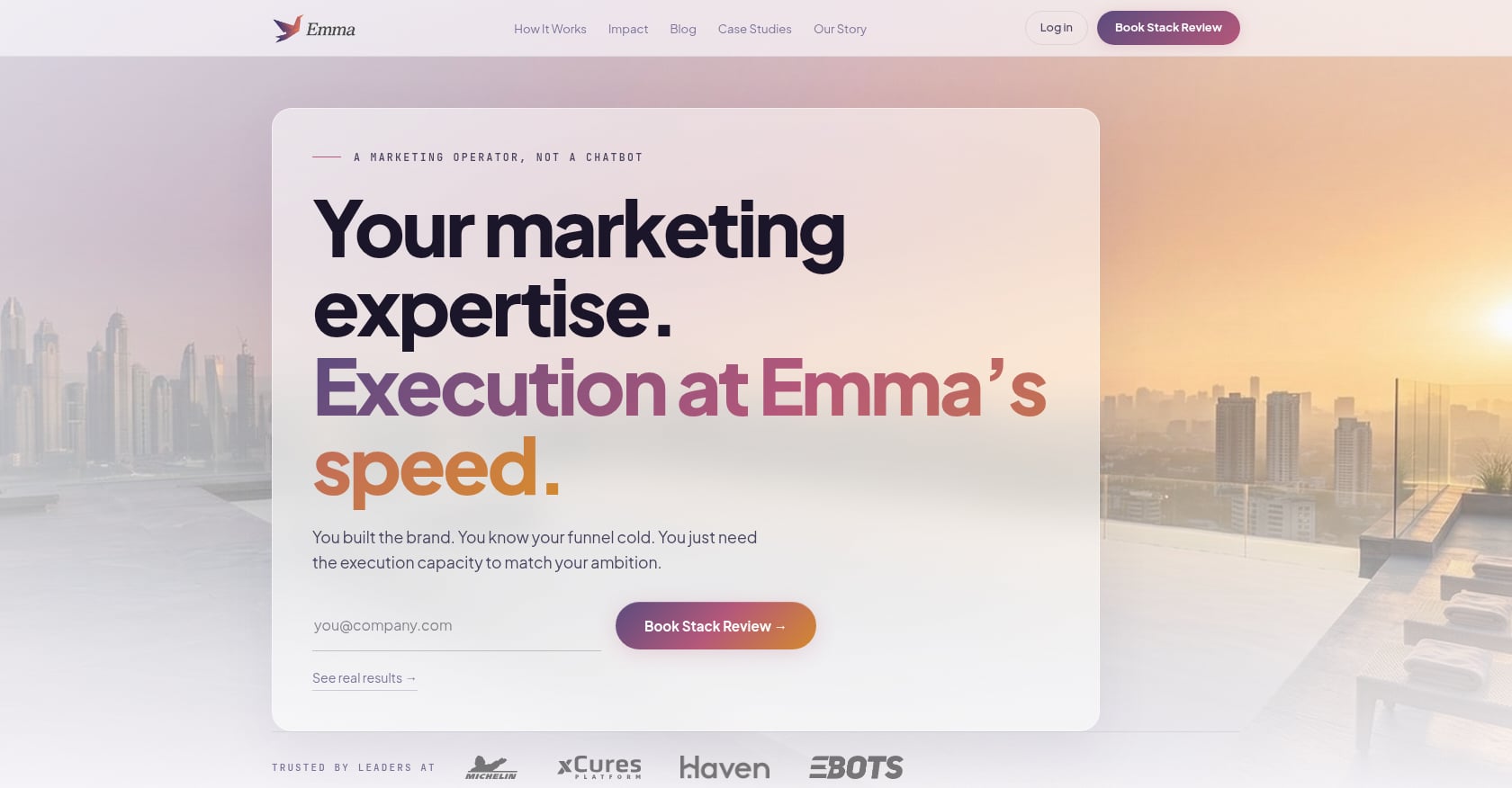
Best for: Full-stack GTM execution with human oversight, especially pre-seed to Series A startups.
AgentWeb isn’t just an outbound tool. It’s an AI + human go-to-market execution service. Emma, the AI agent, orchestrates research, planning, creative production, and reporting across Meta, Google, LinkedIn/X, email, and outbound channels. Senior operators lead strategy while Emma handles weekly execution.
What makes this different from every other tool on this list is the scope. Most B2B lead generation AI agents focus narrowly on cold email. AgentWeb covers the marketing side too: paid social, SEO, content, and founder branding. That’s a category gap the rest of this market hasn’t filled.
Pricing:
DIY self-serve platform: $199/mo (7-day free trial)
Custom workflows and done-for-you: contact sales at founders@agentweb.pro
Key features:
Week 0 GTM diagnostic produces a concrete 90-day GTM plan mapped to ICP, channels, and bottlenecks
Agentic execution across Meta, Google, LinkedIn, email, and SEO
Slack/Teams approval workflows so founders maintain control without slow email chains
Founder brand support including LinkedIn ghostwriting and executive comms
Weekly performance reviews with budget shifts to what works
AgentWeb Portal with dashboards, calendars, and optimization loops
Proof:
4,000+ leads and 328 add-to-carts in 3 months for Nailed It, with 2.91% CTR at roughly $0.24 CPC (see the full case study)
13.19% CTR peak for Cora on a $300/month ad budget
Limitations:
Only two published case studies; newer brand with less external review coverage than larger platforms
Best experience requires teams that use Slack/Teams and engage weekly
Full pricing for services isn’t published on the website
Why it matters in 2026: The human-in-the-loop model directly addresses the biggest failure mode in this market. More on that below.
Get a free AI evaluation for your GTM stack.
2. Apollo.io
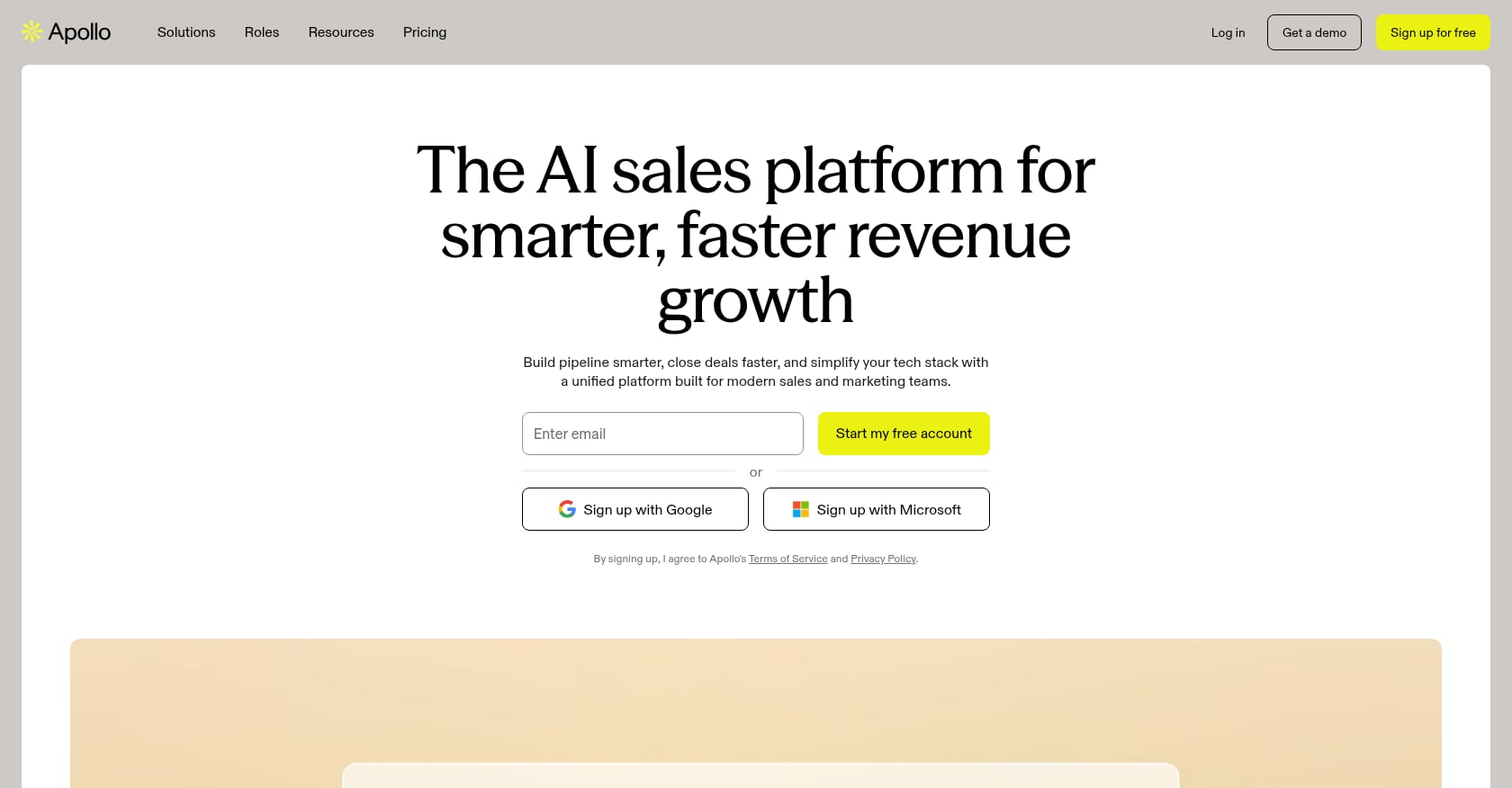
Best for: Budget-friendly all-in-one for small US-focused outbound teams.
Apollo combines a massive B2B contact database (275M+ contacts) with built-in email sequencing, a dialer, and AI-powered personalization. It’s the most reviewed tool in this category on G2, with over 9,200 reviews and a ~4.8/5 rating.
Pricing:
Free tier available
Basic: $49/user/month (annual)
Professional: $79/user/month (annual)
Organization: $119/user/month (annual)
Key features:
Large proprietary database with email and phone data
Built-in email sequencing and dialer
AI-assisted message personalization
Intent signals and lead scoring
Limitations:
Real-world data accuracy hovers around 65-70% according to user reviews, with email bounce rates of 15-25% reported across G2 and Trustpilot
Single-source database with no waterfall enrichment. If Apollo doesn’t have a contact, there’s no fallback.
Credit-based limits and feature gates mean actual costs often run 2-3x the advertised rate. Teams doing heavy outbound should budget $150-$400/user/month.
No native LinkedIn automation
Credits expire, which creates pressure to use them quickly rather than strategically
User perspective: Practitioners on G2 consistently praise Apollo’s breadth of features at the price point but flag data accuracy as the primary frustration, especially for contacts outside the US.
3. Clay
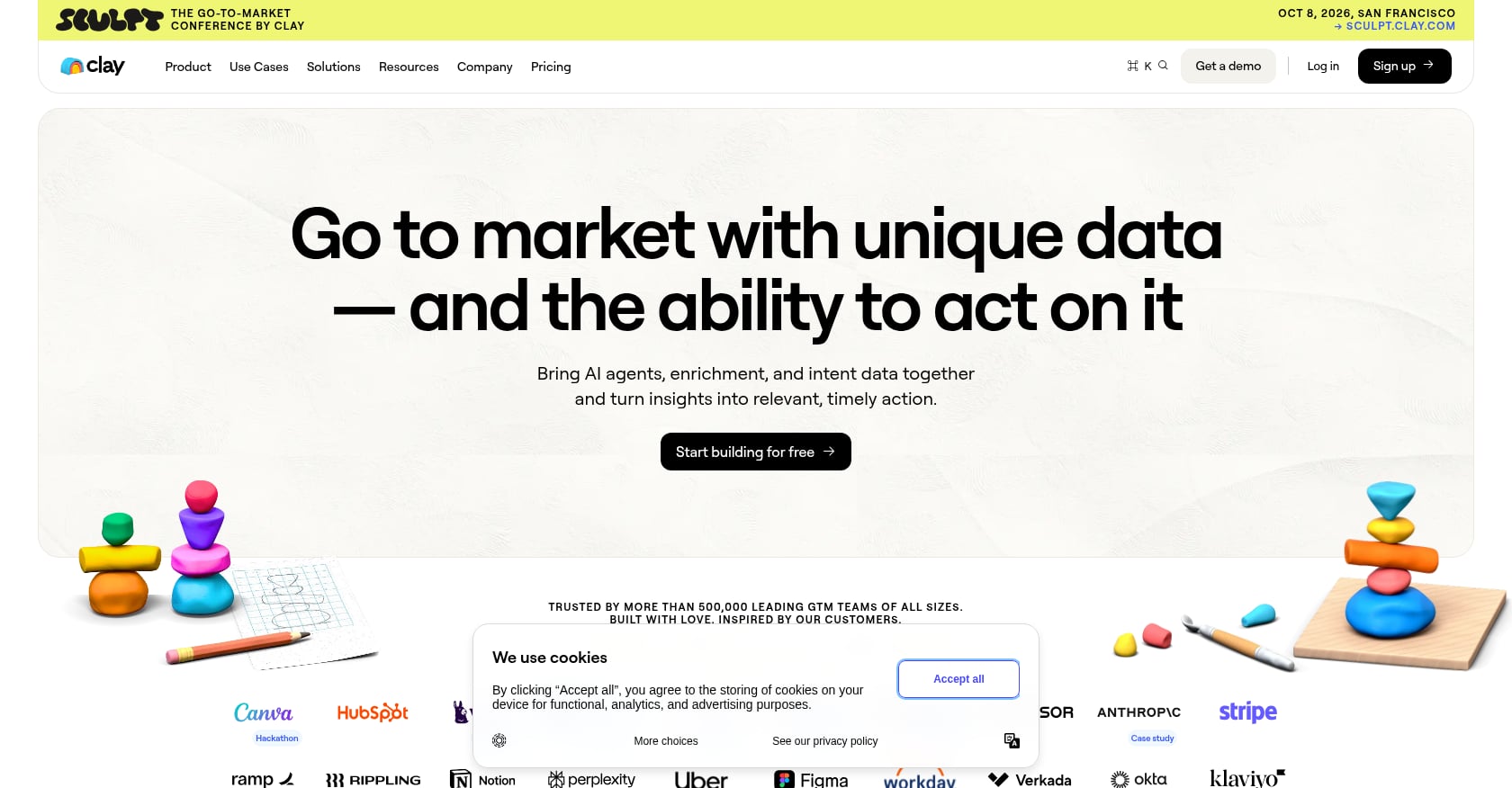
Best for: Technical RevOps teams building custom enrichment and scoring workflows.
Clay isn’t a classic lead generation tool. It’s a data orchestration layer that sits on top of 150+ data providers and gives you a spreadsheet-like canvas to build custom enrichment, scoring, and research workflows. If you want granular control over how your data gets assembled, Clay is unmatched.
Pricing:
Launch plan: $167/month (annual)
Credit-based consumption model
High-volume users can spend $500-$2,000+/month
Key features:
Waterfall enrichment across 150+ data providers
Claygent, an AI research agent that reads websites, scans LinkedIn, pulls recent news, and returns structured outputs
Spreadsheet-like interface for building multi-step workflows
Integrations with CRMs and outbound tools
Limitations:
No native email sequencing. You need a separate sending tool, which adds cost and complexity.
The spreadsheet paradigm is challenging for non-technical users
True cost of ownership is Clay plus your sending tool plus your data provider credits
User perspective: Clay maintains a 4.9/5 rating on G2 with over 500 reviews. The community loves the flexibility but acknowledges the learning curve. For a deeper comparison of enrichment options, see this breakdown of AI lead enrichment tools.
4. Amplemarket
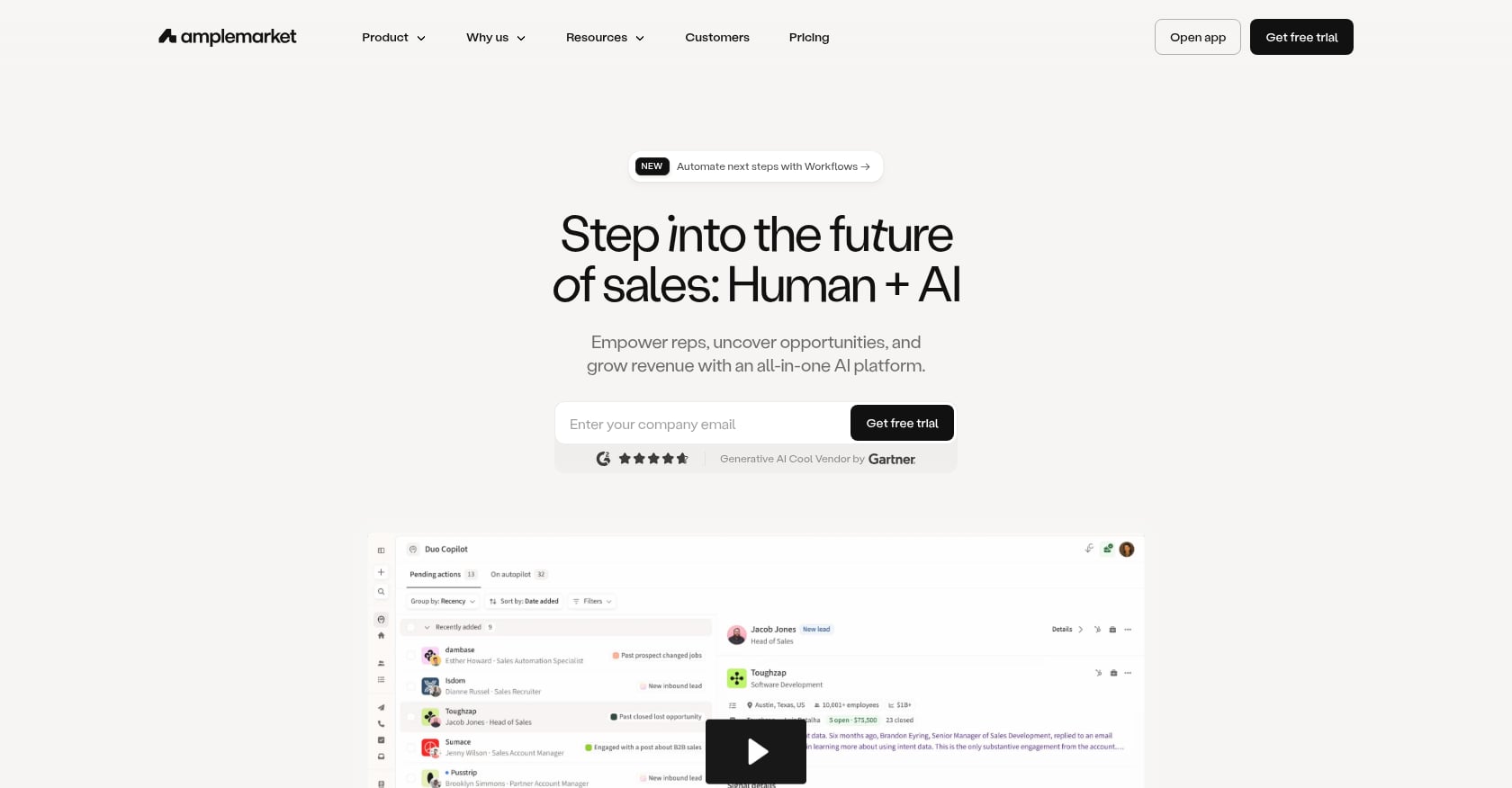
Best for: Signal-driven all-in-one platform for mid-market and enterprise sales teams.
Amplemarket is arguably the most complete signal-driven platform on the market. It combines contact data, real-time buying signals, an AI copilot, multichannel execution, and deliverability infrastructure into one system. Their Duo product features three specialized agents working within a human-in-the-loop approval model.
Pricing:
Not publicly listed
Enterprise-grade, requires a demo
Expect mid-five-figures annually based on market positioning
Key features:
Native data plus real-time intent and signal tracking
Amplemarket Duo: three specialized agents with continuous learning loops
Built-in deliverability infrastructure
Multichannel execution across email, LinkedIn, and phone
Human approval workflows
Limitations:
Pricing opacity makes it hard to compare
Primarily focused on enterprise and mid-market. Overkill for pre-seed startups.
Complex onboarding for small teams without dedicated RevOps
User perspective: Amplemarket’s workflow-role framework (data, intent, orchestration, outbound) has become a reference model in the industry. Their signal-driven approach represents where the market is heading, even if it’s priced above what most startups can justify.
5. 11x.ai (Alice + Julian)
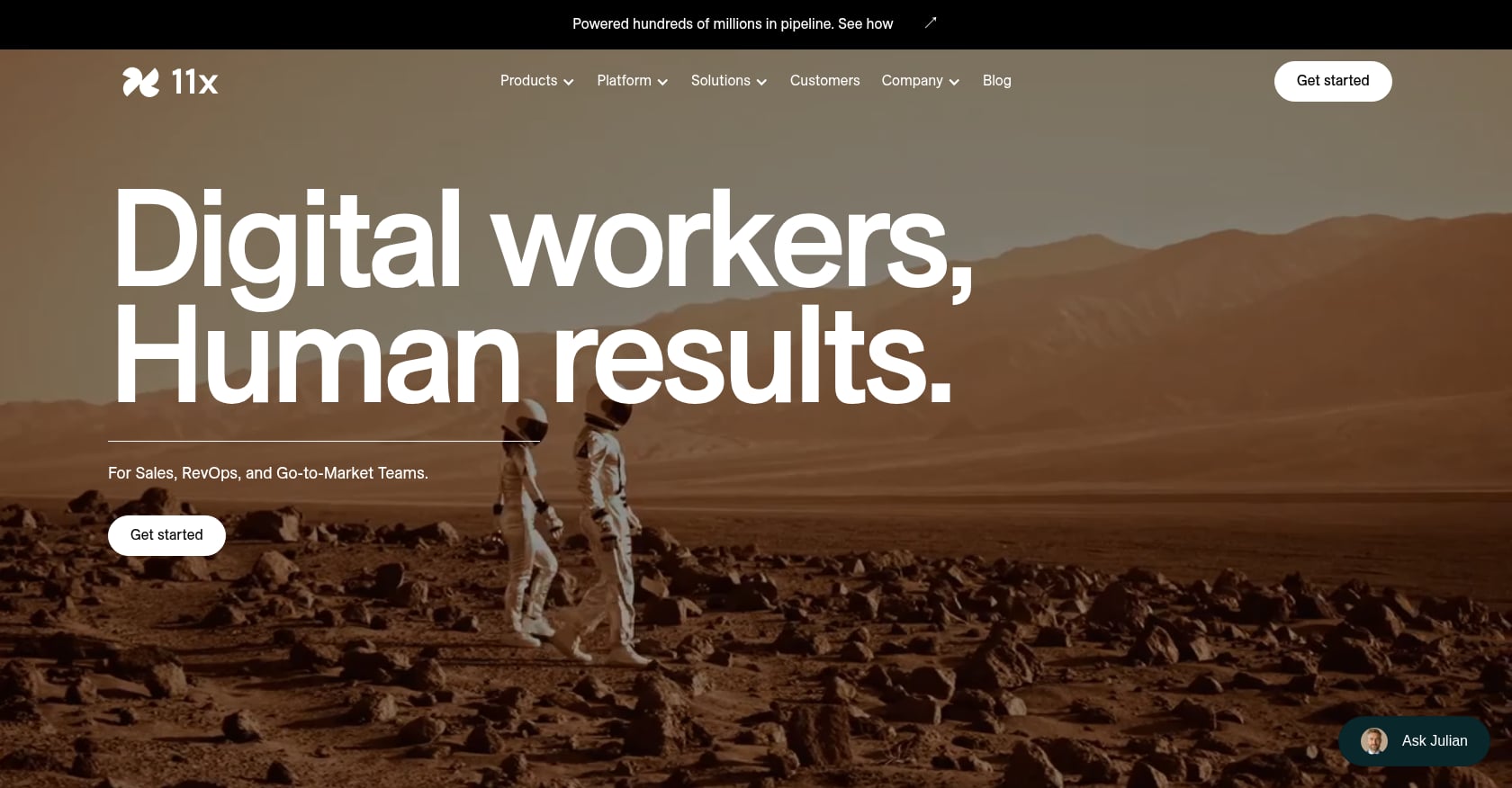
Best for: Enterprise teams wanting autonomous outbound and inbound call handling at scale.
11x builds purpose-built AI agents for enterprise sales. Alice handles outbound lead generation. Julian manages inbound qualification, phone conversations, and meeting scheduling. The vision is autonomous, not augmented.
Pricing:
Alice: $3,750/month (billed annually)
Julian Voice: $5,333/month
Julian Chat: $2,417/month
Median contract value: $45,000/year according to Vendr, with deals ranging from $39,750 to $65,640
Key features:
Autonomous outbound email sequences via Alice
Inbound phone and chat qualification via Julian
Meeting scheduling and handoff
Enterprise-grade security and compliance
Limitations:
No proprietary B2B contact database. Users must bring their own data from ZoomInfo, Apollo, or similar, adding $10K to $50K+ in annual costs.
Annual contract lock-in with no self-serve pricing
The most consistent criticism on G2 (4.5/5 from 30 reviews): Alice’s outreach doesn’t feel personal enough, even after providing detailed ICP information
User perspective: One SDR director who tested 11x reported on forums that “both Artisan and 11x cannot handle replies at all” and “didn’t quite meet the expectations we had for automation, personalization, and reply handling.” This aligns with the broader pattern of pure-AI outbound underperforming human-assisted approaches.
6. Salesforge (Agent Frank)
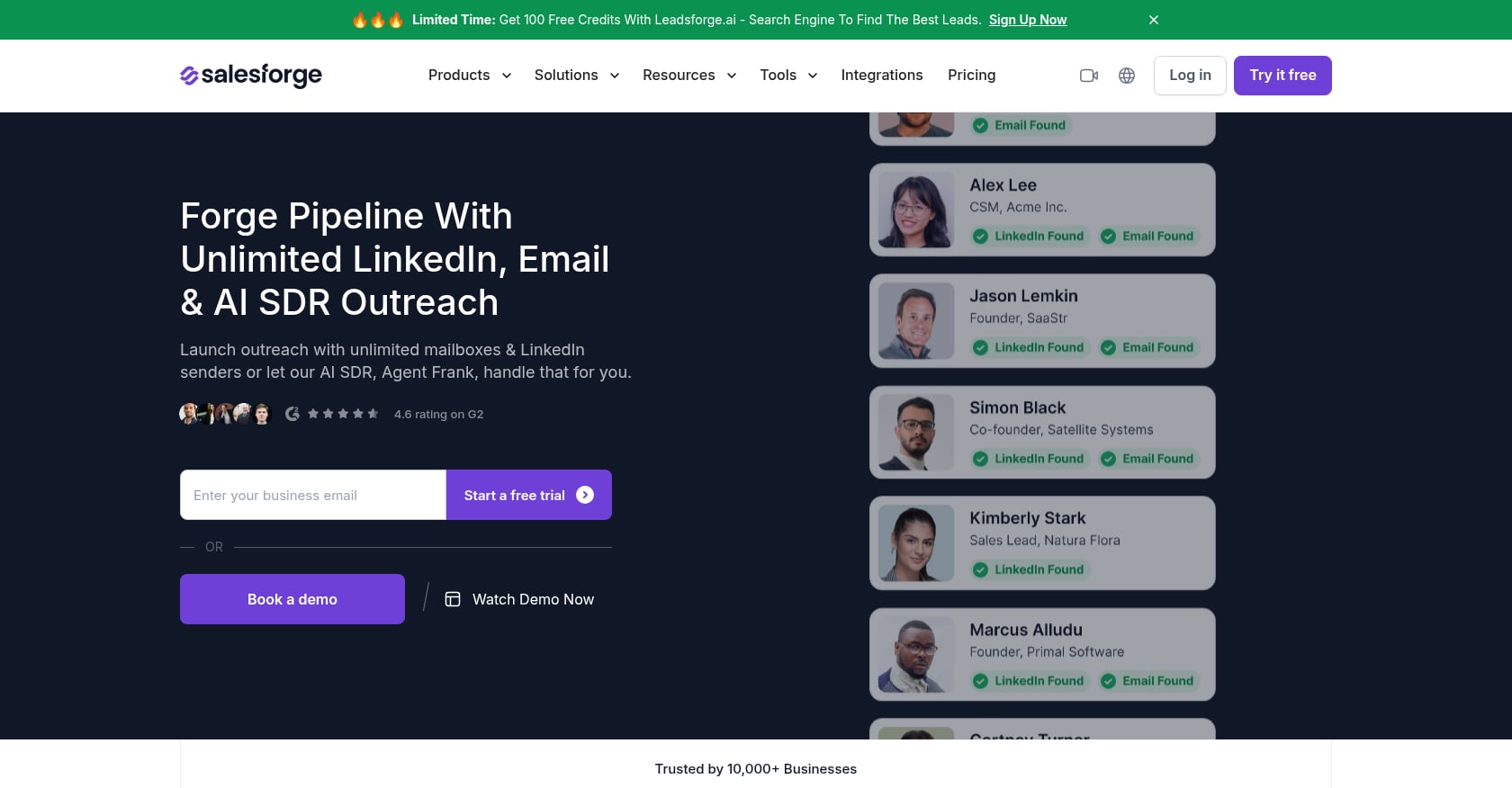
Best for: Affordable AI SDR automation for small teams on a budget.
Salesforge’s Agent Frank offers autonomous prospecting with both Auto-Pilot and Co-Pilot modes. The Co-Pilot option lets you review and approve messages before they go out, which addresses some of the brand safety concerns that plague fully autonomous tools.
Pricing:
Agent Frank: $499/month (annual or quarterly) or $599/month (monthly)
Growth Plan: $80/month for the email platform only
Key features:
Autonomous prospecting workflow management
Auto-Pilot (fully autonomous) and Co-Pilot (human review) modes
Email sequence creation and optimization
Built-in deliverability tools
Limitations:
Requires a 2-week warm-up period before full-speed activation
Message quality is mixed based on practitioner reports
No built-in lead scraping, so you need a separate data source
Less focused on personalization compared to tools that build context from live data
User perspective: Salesforge positions itself as having “tested 5 tools across 1,000+ sequences,” which adds credibility to their claims. But the warm-up delay and BYO data requirement mean real time-to-value is longer than the marketing suggests.
7. Artisan AI (Ava)
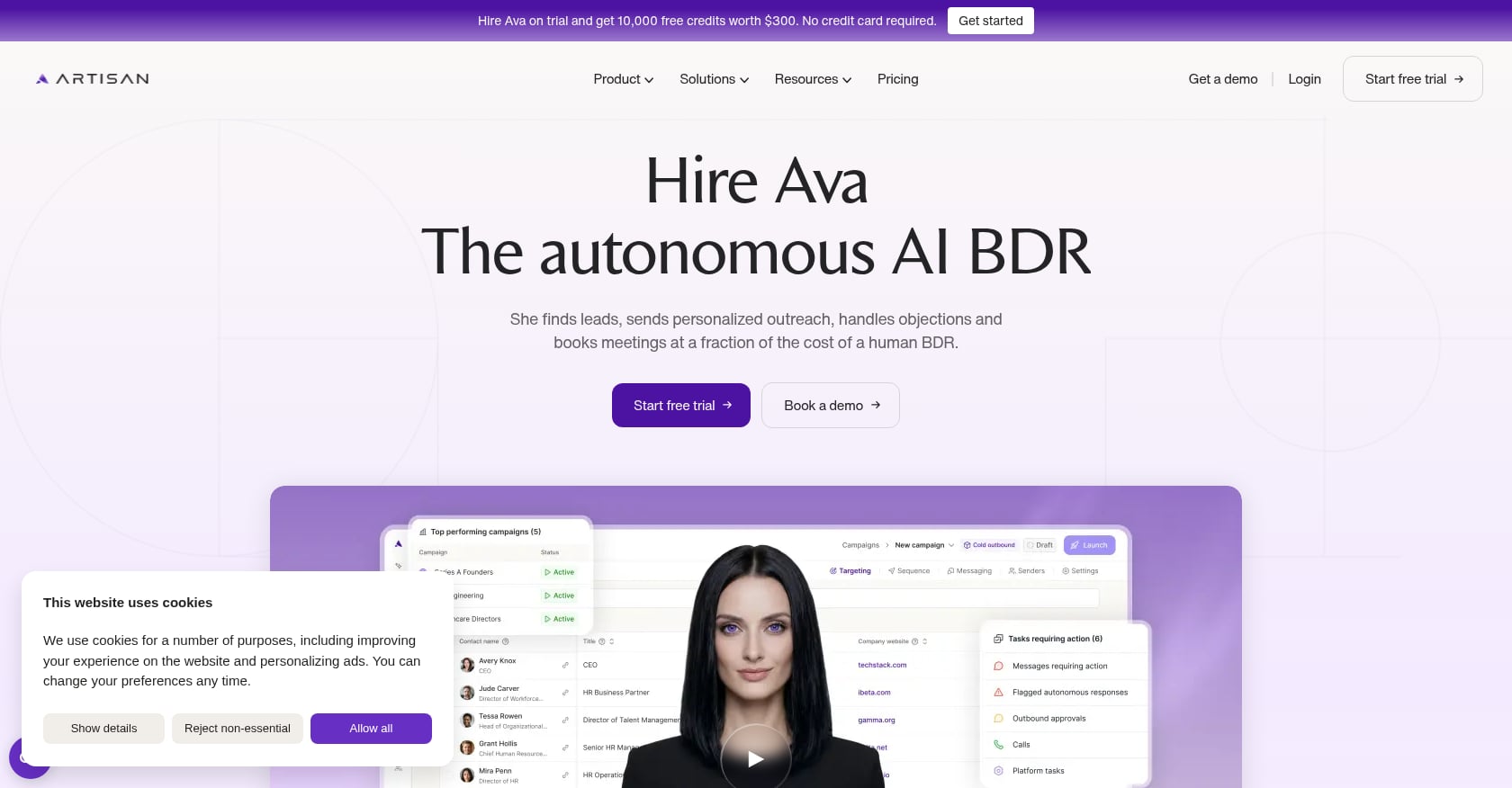
Best for: Mid-market teams wanting built-in data and outbound in one platform.
Artisan’s AI BDR, Ava, automates prospecting, data enrichment, and personalized outreach from a single platform. With 300M+ B2B contacts across 200+ countries, it removes the BYO data requirement that plagues 11x and Salesforge.
Pricing:
Custom pricing (gated behind sales)
Starting at roughly $999/month based on published comparisons
Key features:
Large built-in contact database (300M+)
Automated prospecting and sequence management
LinkedIn outreach (beta)
Multi-language support
Limitations:
G2 rating sits at 3.8-3.9/5 from 22 reviews, with a polarized distribution
G2’s most common complaint tags: “Inaccuracy” and “Limited Functionality”
Multiple verified reviews cite “zero quality leads” and “messaging is extremely bland” despite the “hyper-personalization” positioning
Pricing requires talking to sales, which slows evaluation
User perspective: The gap between Artisan’s marketing (hyper-personalized, human-like outreach) and user experience (robotic, generic messages) is the widest of any tool on this list. The 300M+ database is genuinely useful, but the output quality needs significant improvement.
8. B2B Rocket
Best for: High-volume AI agent-driven prospecting at scale.
B2B Rocket uses AI agents to automate outreach and lead generation, with a focus on volume. The platform ranked 45th out of 4,664 products in the 2026 G2 Best Software Awards, which signals strong user satisfaction at scale.
Pricing:
Custom pricing; contact sales for quotes
Key features:
AI agents that automate outreach sequences
High-volume prospecting capabilities
Lead qualification and scoring
CRM integration
Limitations:
Primarily email-focused, less suited for multichannel or full-funnel marketing needs
Limited public pricing information
Less suited for teams that need marketing-side lead generation (content, SEO, paid social)
User perspective: One customer reported increasing their new revenue pipeline by $5M+ and discovering new global partnerships. The G2 ranking is impressive, but as with all volume-focused tools, quality per lead matters more than total leads generated.
9. Lindy
Best for: Building custom AI agent workflows without engineering resources.
Lindy provides a flexible platform for creating AI agents that enrich profiles, score leads, and connect to Google Sheets, Airtable, Notion, or CRMs. You define your ideal customer and outreach goals, and Lindy creates an autonomous agent that reaches out via email or LinkedIn.
Pricing:
Usage-based model; not prominently published
Key features:
Custom AI agent builder with no-code interface
Agents that adapt messaging, respond to replies, and track engagement
Integrations across data tools, CRMs, and outreach channels
Lead enrichment and scoring capabilities
Limitations:
Pricing opacity makes budgeting difficult
Requires significant setup time to define workflows properly
Less structured than purpose-built platforms, which means more decisions fall on the user
No built-in contact database
User perspective: Lindy’s first-person accounts of building custom agents are compelling for technically curious teams. But for founders who want to generate leads this week, the setup overhead may be a dealbreaker. Teams interested in autonomous approaches should also explore autonomous lead generation tools for startups.
Why Human-in-the-Loop Wins in 2026
Here’s the uncomfortable truth about B2B lead generation AI agents: the fully autonomous model is underperforming.
Around 50-70% of AI SDR tools churn within a year. Gartner expects 40% of agentic AI projects to be abandoned by 2027. The pattern is clear: teams buy the promise of “set it and forget it,” then discover that unsupervised AI produces mediocre results at best and brand damage at worst.
The core problem is that buyers can detect AI cold email now. Two years ago, a well-personalized AI message could pass for a sharp human SDR. Today it can’t. Buyers have read enough AI-written emails to recognize the cadence, the structure, the slightly-too-tidy openers. Reply rates on pure-AI sequences have fallen quarter over quarter for two years straight.
A practitioner review on Indie Hackers put it bluntly: “Pure-AI was the wrong era’s play. Done-for-you was the era before that. The 2026 play is AI doing the volume work it’s good at (prospecting, enrichment, draft generation) plus a real human doing the work AI can’t do well (final review of every message, real-time reply handling, judgment calls on warm leads).”
There’s also the brand risk angle that nobody talks about enough. An unsupervised AI agent can burn through your entire addressable market in a weekend. For revenue leaders, the primary barrier to adoption isn’t cost. It’s the possibility that a rogue sequence torches your reputation with the exact accounts you most want to close.
This is why platforms with built-in human approval workflows are outperforming autonomous-only tools. AgentWeb was designed around this principle from day one, with Slack/Teams approval loops and senior operators reviewing strategy weekly. Amplemarket’s Duo model takes a similar approach at the enterprise level. For a deeper look at how this model works, read the agentic AI marketing platform guide.
The winning formula in 2026 is clear: let AI handle research, data enrichment, draft generation, and scheduling. Let humans handle judgment, approval, relationship nuance, and brand voice.
Technical Prerequisites: What You Need Before Deploying an AI Agent
Picking a tool is only 20% of the battle. If you drop a highly advanced AI agent onto raw, unoptimized infrastructure, you will burn your domains and tank your sender reputation. Ensure your RevOps team has finalized this checklist before onboarding any agent:
1. Technical Domain Setup
Do not use your primary corporate domain for automated outreach. Set up 3 to 5 secondary domains (e.g., if your site is company.com, buy getcompany.com or companylabs.io).
Authentication Required: Implement full SPF, DKIM, and DMARC records for every secondary domain to bypass spam filters.
Warm-Up Protocol: Run all new domains through a specialized email warm-up service for a minimum of 14 days before pointing an agent to them.
2. ICP and Data Segmentation
AI agents cannot guess your ideal customer profile (ICP). They operate on the data parameters you feed them.
Plan to invest roughly 40 to 60 hours cleaning your primary target list, filtering out bad firmographic data, and mapping out exact account tiers.
The Rule of Input: If you feed an AI agent a list with 30% bad data, your output will see a 30% drop in deliverability, invalidating your tool spend.
How to Choose the Right AI Agent for Your Team
The right B2B lead generation AI agent depends on your stage, budget, and what kind of leads you actually need. Here’s a framework:
Pre-seed or solo founder (budget under $500/month):
Start with AgentWeb’s DIY platform at $199/month or Apollo’s free tier. You need something that ships campaigns weekly without requiring a team. At this stage, you can’t afford to spend 30 hours a week managing tools. Founders looking for predictable lead generation without hiring should prioritize execution speed over feature depth.
Seed stage with some budget ($500-$2,000/month):
AgentWeb’s custom workflow tier or Clay paired with a sending tool. If your team has technical ops capacity, Clay’s enrichment power is unmatched. If you want marketing and outbound covered without building a stack, AgentWeb’s hybrid model is more practical.
Series A with dedicated sales ($2,000-$5,000/month):
AgentWeb’s done-for-you service or Amplemarket. Both provide human-in-the-loop oversight. The difference: AgentWeb covers marketing-side lead generation (content, paid, SEO, founder brand) while Amplemarket focuses on outbound sales execution.
Enterprise ($5,000+/month):
11x for autonomous outbound at scale, or build a custom stack with Clay + Amplemarket + a content engine. Budget for BYO data costs on top of platform fees.
Key evaluation criteria to apply regardless of stage:
Data quality: The real question isn’t which AI agent to pick. It’s whether your data is good enough to feed one. Teams regularly burn through three months of an annual contract before realizing the problem was the contact list, not the AI. Expect 40-60 hours of data cleaning and segmentation before launch.
Channel coverage: Do you need just outbound email, or do you also need inbound marketing (SEO, content, paid social, founder brand)?
Human oversight: What approval workflows exist? Can you review messages before they go out?
Total cost of ownership: Include data providers, sending tools, warm-up time, and the hours your team spends managing the platform.
Time-to-value: How long before you see actual qualified leads, not just sent emails?
The Hidden Cost Problem Nobody Talks About
Every tool in this space has costs that don’t show up on the pricing page. Understanding them is the difference between a smart investment and a money pit.
Apollo’s real cost is 2-3x its sticker price. Credit-based limits, feature gates, and data accuracy gaps mean a $49/user/month plan actually runs $150-$400/user/month for teams doing serious outbound. Credit expiration compounds this by creating urgency that leads to wasteful sending.
11x requires BYO data, adding $10K-$50K annually. The $45,000 median contract is just the platform. You still need ZoomInfo, Apollo, or a similar database underneath it. Total cost for 11x plus data often exceeds $60,000-$100,000 per year.
Clay needs a sending tool. That $167/month Launch plan doesn’t send a single email. Add Instantly, Smartlead, or a similar tool at $50-$200/month, plus the data credits that scale with usage.
The warm-up tax is real. Salesforge requires a 2-week warm-up. 11x users report 3-month ramp periods. That’s time where you’re paying but not generating leads.
The “SDR tax” persists even with AI. Industry experts describe this as the 15-30 hours per week that sales reps spend on non-selling tasks: cleaning lists, managing deliverability, troubleshooting integrations. Most AI tools reduce this but don’t eliminate it. Only fully managed services, where someone else handles the operations, actually remove the SDR tax entirely. For more on how AI pipeline automation tools can reduce this overhead, see our comparison.
The cost of getting it wrong: An AI SDR delivers roughly $39 per lead versus $262 for a human SDR, representing an 85% cost reduction. But that math only works when the AI is producing quality leads. Generic messages that damage your brand reputation have costs that never show up in a spreadsheet.
Performance Benchmarks: AI Agents vs. Human SDR Workflows
To accurately project your pipeline return on investment, you must analyze performance using actual industry tracking benchmarks:
Performance Metric | Traditional Human SDR | Fully Autonomous AI Agent | Human-in-the-Loop (HITL) Model |
Daily Output Volume | 50–80 activities | 1,000+ activities | 300–500 targeted activities |
Avg. Cost Per Lead | ~$262 | ~$39 | ~$65 |
Average Reply Rate | 3% – 5% | less than 1% (due to filters) | 6% – 8.5% |
Brand Reputation Risk | Very Low | High (Unsupervised output) | Low (Human Checked) |
Setup Time-to-Value | 2–3 Weeks (Hiring/Ramp) | 4–8 Weeks (Warm-up & Data) | 1–2 Weeks (Managed Setup) |
FAQ
Can AI agents fully replace human SDRs?
Not in 2026. The data is clear on this. The highest-performing teams use AI for research, enrichment, draft generation, and scheduling while humans handle final review, reply management, and judgment calls on warm leads. Fully autonomous AI SDR approaches have underperformed, with churn rates of 50-70% within a year. The sweet spot is a human-in-the-loop model where AI handles 80% of the volume work and humans provide the 20% that requires nuance.
What’s the average cost of a B2B lead generation AI agent?
It varies wildly by category. Budget tools like Apollo start at $49/user/month (though real costs run higher). Mid-range AI SDRs like Salesforge cost $499-$599/month. Enterprise platforms like 11x start at $3,750/month before data costs. Full-stack services like AgentWeb start at $199/month for self-serve. A fully loaded human SDR costs $75,000-$110,000 annually, while an enterprise-grade AI SDR solution typically ranges from $15,000 to $35,000 per year.
How long before I see results from an AI lead gen agent?
Expect 4-8 weeks minimum. Most tools require a warm-up period (1-2 weeks for email deliverability), data setup time (plan for 40-60 hours of cleaning and segmentation), and iteration cycles to refine messaging and targeting. Claims of “instant results” are marketing. Tools with managed services can compress timelines because the operational setup is handled for you.
What data do I need before deploying an AI agent?
At minimum: a clear ICP definition, a clean contact list (or budget for one), verified email domains with proper authentication (SPF, DKIM, DMARC), and enough content or messaging to personalize at scale. The single most common failure mode is deploying an AI agent on top of dirty data and blaming the tool when results are poor.
Why do most listicles only cover outbound AI SDR tools?
Because outbound-only tools are easier to compare (they all send emails) and the category is more crowded. But real B2B lead generation happens across both inbound and outbound channels. Content marketing, SEO, paid social, and founder branding all generate leads. The full-stack category that combines marketing and outbound is newer, which is why it’s underrepresented in most comparisons.
What’s the biggest risk of using an AI lead generation agent?
Brand damage from unsupervised outreach. An AI agent that sends generic or poorly timed messages to your target accounts can burn relationships that took years to build. This is why approval workflows and human oversight aren’t nice-to-haves. They’re requirements for any team that cares about long-term reputation. Read more about brand-safe AI marketing to understand the framework.
Should I start with a tool or a managed service?
If you have a dedicated ops person who can spend 15-30 hours per week managing the tool, a self-serve platform works. If you’re a founder or small team without that capacity, a managed service gets you to results faster because someone else handles the data cleaning, deliverability management, and campaign optimization. Many teams start with managed service to validate channels, then transition to self-serve once they know what works.
Is it worth paying more for a human-in-the-loop model?
Yes, based on current evidence. Pure-AI models are cheaper upfront but produce lower-quality leads and higher churn. The cost difference between a $499/month autonomous tool and a managed service is often recovered in the first month through better lead quality, fewer wasted sequences, and zero brand risk incidents. The economics of AI lead generation only work when the output is good enough to convert.
Ready to figure out which approach fits your team? Get a free AI evaluation to see where AI agents can drive the most impact in your go-to-market motion.
Or get a free AI Readiness Roadmap to see where your GTM has gaps.
Ex-Meta, Google, LinkedIn. 10+ years in ML & data science for GTM. Expert in customer acquisition and growth activation.
Get a free Stack Review.
30 min with Harsha and Matt.
We audit your last 30 days, pinpoint the highest-impact fixes, and hand you the exact playbook we'd run. No deck. No pitch unless there's a fit.