10 Best AI Market Research Tools (2026) For GTM Teams


TL;DR
AI market research tools can speed up audience discovery, competitor analysis, and survey design, but they do different jobs and produce different levels of evidence. The best choice depends on the decision you need to make. For startups that need research connected to campaign execution, AgentWeb is the strongest fit. For source-backed desk research, use Perplexity. For audience intelligence, SparkToro and GWI stand out. For customer interview analysis, Dovetail wins. This guide compares 10 tools by use case, pricing, data source, user sentiment, and honest limitations.
Why AI Market Research Tools Are Not Interchangeable
AI-powered market research uses machine learning, natural language processing, and predictive analytics to uncover consumer insights faster and at scale, according to GWI’s definition. Common use cases include survey automation, trend analysis, sentiment analysis, competitive intelligence, and data visualization.
That sounds neat until you realize that a tool summarizing web pages and a tool running structured survey panels are doing completely different work. They produce different types of evidence. They serve different decisions. And they fail in different ways.
MRII’s 2026 State of the Market Research Industry report, based on a survey of 498 global insights professionals, found optimism about AI but uneven adoption and persistent integration challenges. The profession is still figuring out where AI fits, and where it does not.
If you are a startup founder, growth marketer, product marketer, or agency consultant, the question is not “should I use AI for market research?” The question is: which tool matches the decision I need to make, and what happens after I get the insight?
Explore AgentWeb’s AI-powered GTM workflows to see how research connects to execution.
At-a-Glance Comparison Table
| Tool | Best for | Starting price | Primary data source | G2 rating | Key tradeoff |
|---|---|---|---|---|---|
| AgentWeb | Startup GTM research + execution | $199/mo (7-day free trial) | Client ICP, market/competitor data, campaign inputs | Case studies available | Not a standalone survey panel |
| ChatGPT | Research framing and synthesis | Free; Plus $20/mo | User-provided data, web search | 4.7/5 (1,000+ reviews) | Can hallucinate niche facts |
| Perplexity | Source-backed desk research | Pro $20/mo | Web sources with citations | 4.5/5 (276 reviews) | Citations still need verification |
| SparkToro | Audience and channel discovery | Free; Personal $50/mo | Web/social audience affinities | 4.5/5 (12 reviews) | Weaker outside US/English markets |
| GWI | Survey-backed consumer insights | Free; Plus $150/user/mo | 35B+ consumer survey data points | 4.4/5 (186 reviews) | Less useful for niche B2B audiences |
| Brandwatch | Enterprise social listening | Custom quote | Social, forums, online conversations | 4.4/5 (722 reviews) | Enterprise pricing and complexity |
| Quantilope | Structured quant research | Custom/subscription | Survey panels | 4.2/5 (67 reviews) | More than most startups need |
| Dovetail | Customer interview analysis | Free; paid plans vary | Interviews, calls, support tickets | 4.5/5 (167+ reviews) | Needs organized input data |
| SurveyMonkey | Fast surveys and forms | Free; Standard $99/mo | Survey respondent data | 4.4/5 (23,513 reviews) | Advanced features locked behind paid tiers |
| Browse AI | Competitor web monitoring | Free; Personal $48/mo | Public websites (scraped) | 4.8/5 (59 reviews) | Collects data, does not interpret it |
How to Choose: The AI Market Research Evidence Ladder
Most competitor guides list tools without explaining how much confidence you should place in the output. This matters. A ChatGPT brainstorm and a structured consumer panel study are not the same kind of evidence, and treating them equally leads to bad decisions.
| Evidence level | Example tools/methods | Confidence | Best use |
|---|---|---|---|
| Level 1: LLM hypothesis generation | ChatGPT, Claude, Gemini | Low to medium | Brainstorming personas, research questions, assumptions |
| Level 2: Source-backed desk research | Perplexity, ChatGPT deep research | Medium | Market scans, competitor summaries, trend briefs |
| Level 3: Public audience signals | SparkToro, Brandwatch, Reddit | Medium | Channel selection, messaging language, competitor monitoring |
| Level 4: Existing customer data | Dovetail, Gong, support tickets, reviews | Medium to high | Objection mining, customer language, churn drivers |
| Level 5: Structured surveys/panels | GWI, SurveyMonkey, Quantilope | High (if methodology is sound) | Audience sizing, concept testing, segmentation |
| Level 6: Real market experiments | Landing page tests, paid ads, outbound | Highest | Pricing validation, channel proof, conversion data |
Practitioners on Reddit reinforce this hierarchy. One market research professional explained that if they have to defend a number to leadership and the traceable answer is “a model said so,” the argument collapses. The same discussion noted that AI works well for survey drafts, codeframes, translations, and summaries, but statistical work like weighting and significance testing should not be handed to an LLM.
The rule is simple: if the decision is low-risk, AI-generated hypotheses may be enough. If the decision affects pricing, product roadmap, budget, or launch strategy, require traceable data or live market tests.
The 10 Best AI Market Research Tools
1. AgentWeb
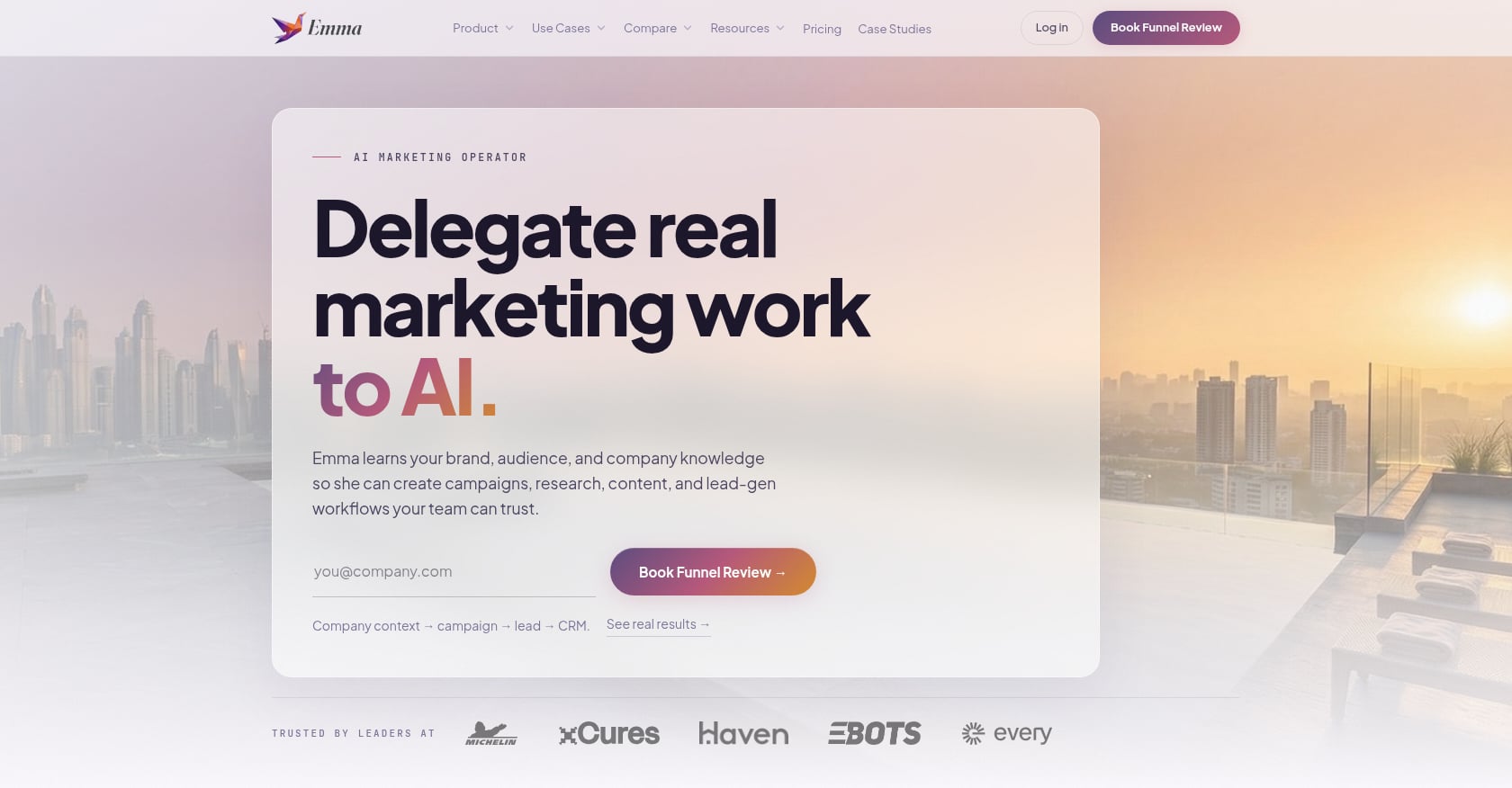
Best for: Startups that need market research turned into GTM campaigns
AgentWeb is not a traditional market research platform. It is an AI plus human go-to-market execution system built for startups and lean teams that cannot afford to let research sit in a document.
Pricing:
- DIY self-serve platform: 7-day free trial, then $199/month
- Custom AI-led co-pilot workflows: contact sales
- Done-for-you Growth Ops: contact sales
- Free GTM Discovery Report available
Key features:
- Market research, competitive analysis, promotion planning, and audience insights templates
- Week 0 diagnostic and 90-day GTM plan
- Emma (agentic AI marketer) executing across Meta, Google, LinkedIn/X, email, and outbound
- Slack/Teams approval workflows for fast creative review
- AgentWeb Portal with calendar, dashboards, and optimization loops
- Founder-brand support including LinkedIn ghostwriting
- SEO and content production
- Weekly performance reviews and iteration
Tradeoffs:
- Not a replacement for enterprise survey panels or academic-grade quant research
- Service pricing beyond the DIY tier is not publicly listed
- Limited third-party review footprint compared to established SaaS tools
Proof: The Nailed It case study shows 4,000+ leads and 328 add-to-carts in 3 months, with 2.91% CTR at roughly $0.24 CPC, outperforming a competing agency in a head-to-head test. The Cora case study shows 13.19% peak CTR on a $300/month ad budget with 435+ qualified clicks in one month.
Verdict: Choose AgentWeb if your question is not just “what should we learn?” but “what should we learn, what should we say, and who is going to ship it?” For teams comparing this against traditional agencies, the AI agent vs agency comparison breaks down the differences.
2. ChatGPT
Best for: Research framing, synthesis, and first drafts
ChatGPT is the Swiss army knife most teams already use. It is best as a research analyst, not a source of truth.
Pricing:
- Free: $0
- Plus: $20/month
- Pro: $200/month
- Business: $20/user/month billed annually (2-seat minimum)
Key features:
- Synthesis of uploaded files, transcripts, and review exports
- Deep research mode with documented reports and citations
- Interview guide and survey draft generation
- Market map and hypothesis creation
- Data analysis on uploaded spreadsheets
Tradeoffs:
- Can hallucinate niche facts, local competitors, or market statistics
- Not a live market database
- Requires source validation for any claim you plan to act on
User sentiment: G2 reports a 4.7/5 rating from 1,000+ reviews. Practitioners on Reddit describe ChatGPT as better for making sense of research and turning findings into ideas, while Perplexity is better for sourced answers.
Verdict: Use ChatGPT with uploaded evidence (transcripts, review exports, competitor pages) rather than asking it to generate facts from memory.
3. Perplexity

Best for: Source-backed desk research and fast competitor scans
Perplexity functions as a cited answer engine. Ask a market research question, get an answer with source links. That makes it useful for quick competitive scans, market sizing starting points, and trend briefs.
Pricing:
- Pro: $20/month or $200/year
- Enterprise Pro: $40/user/month
- Enterprise Max: $325/user/month
Key features:
- Cited answers with source links
- Research mode for multi-step queries
- File upload and analysis
- Saved research and alerts
Tradeoffs:
- Citations are not the same as verification (you still need to open the sources)
- Can over-summarize complex topics
- Usage limits and pricing changes frustrate power users
User sentiment: G2 lists Perplexity at 4.5/5 from 276 reviews. Users praise speed and citations but note variable depth on complex queries.
Verdict: Perplexity is a strong starting point for AI market research, but the analyst still has to judge the sources. Pair it with ChatGPT for synthesis and you cover the first two levels of the evidence ladder.
4. SparkToro
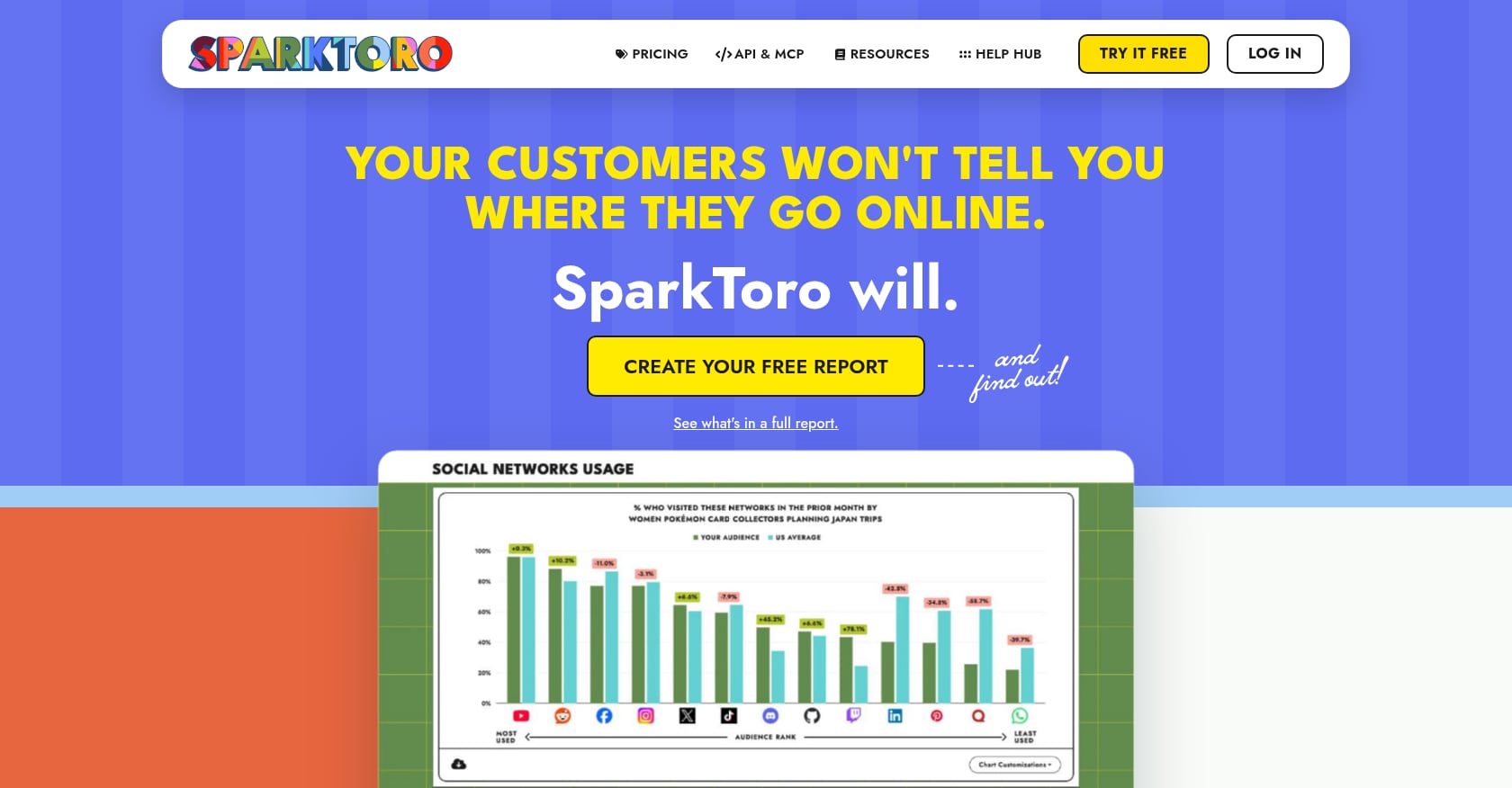
Best for: Audience research and channel discovery
SparkToro answers the question “where does my target audience actually spend attention?” It crawls public web and social data to show what podcasts, websites, YouTube channels, social accounts, and subreddits a given audience follows.
Pricing:
- Free: 3 reports/month, preview data only
- Personal: $50/month
- Business: $150/month, 10 users
- Agency: $300/month, 100 users
Key features:
- Audience web and social affinity data
- Channel discovery (podcasts, sites, YouTube, subreddits)
- Persona builder on paid plans
- Influencer and media planning support
Tradeoffs:
- Not primary research; it aggregates public signals
- Data quality drops outside English-speaking and US markets
- Not built for “why will they buy?” questions
User sentiment: G2 lists SparkToro at 4.5/5 from 12 reviews. Reddit practitioners mention SparkToro as useful for audience overlap and channel discovery but sometimes prefer manually reading Reddit and LinkedIn comments for raw customer language.
Verdict: SparkToro helps you stop guessing where your audience hangs out. Use it to inform your content marketing strategy and channel priorities.
5. GWI (Agent Spark)

Best for: Survey-backed consumer audience insights
GWI grounds its answers in actual survey data from over 2 million annual surveys and 35 billion consumer data points. Its Agent Spark feature lets you ask natural-language questions and get chart-ready answers.
Pricing:
- Free: 10 Agent Spark prompts/month
- Plus: $150/user/month or $1,500/user/year
- Teams and Pro: custom pricing
Key features:
- Survey-backed audience profiling
- Demographic and psychographic insights
- Natural-language queries with chart outputs
- Crosstabs and dashboard exports on higher plans
Tradeoffs:
- Strong when questions fit GWI’s survey coverage
- Less useful for niche B2B audiences or very local markets
- AI output still needs interpretation
- Export and search limitations noted by users
User sentiment: G2 lists GWI at 4.4/5 from 186 reviews. Users praise quick audience analysis but report friction with exports and Agent Spark imperfections on complex comparisons.
Verdict: GWI is strongest when you need quantified audience evidence, not just a smart-sounding summary.
6. Brandwatch Consumer Intelligence
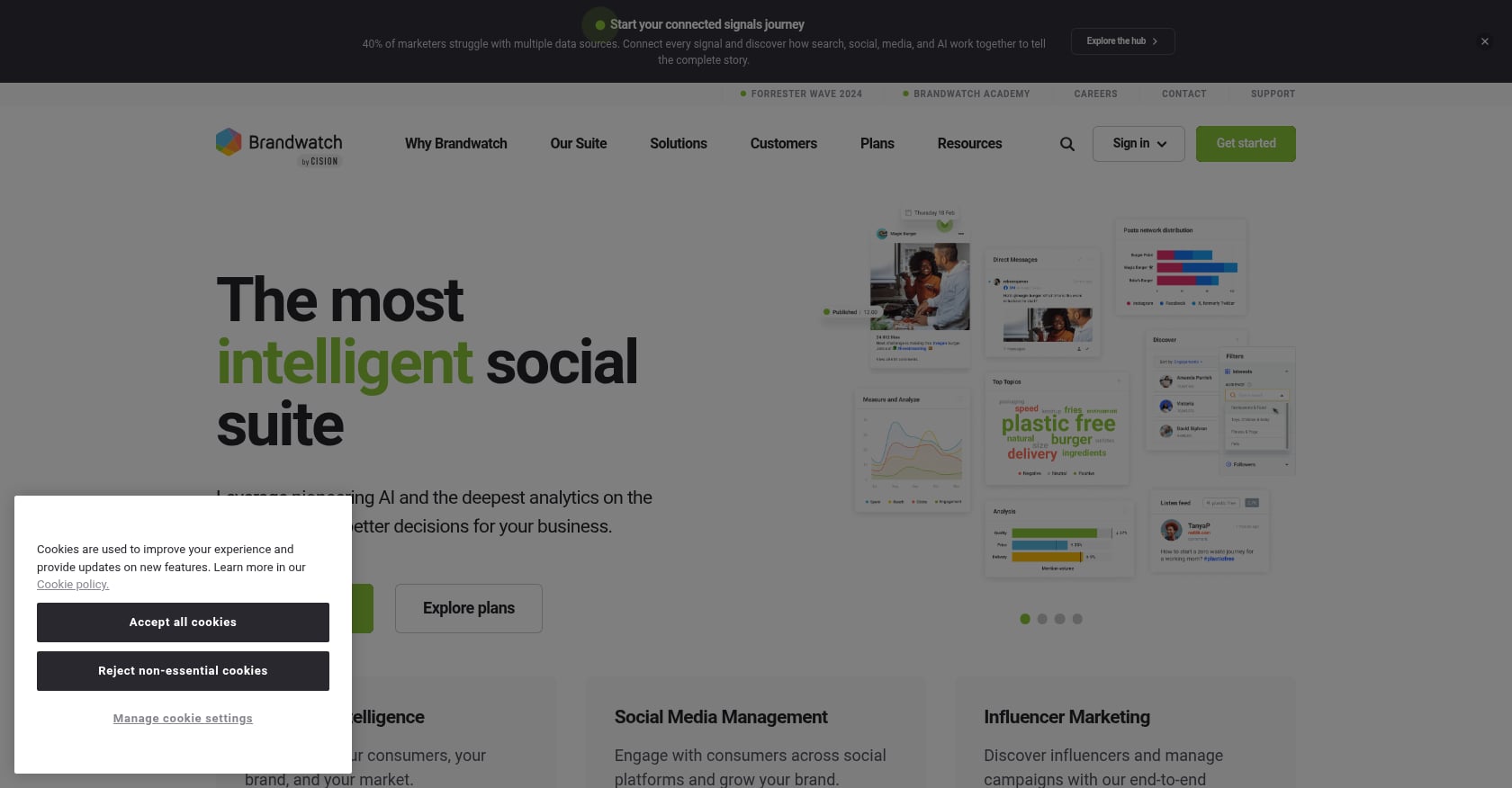
Best for: Enterprise social listening and sentiment tracking
Brandwatch covers social conversations, forums, news, and online mentions at scale. It is built for brand reputation monitoring, share-of-voice analysis, and trend discovery.
Pricing:
- Custom quote only (no public pricing)
Key features:
- AI-enriched social listening across platforms
- Sentiment analysis and trend detection
- Custom dashboards and reporting
- Historical data and broad source coverage
Tradeoffs:
- Enterprise complexity and learning curve
- Custom pricing puts it out of reach for most startups
- Automated sentiment classification still needs human validation
- Not ideal for lean teams that just need a few audience insights
User sentiment: G2 lists Brandwatch at 4.4/5 from 722 reviews. Users praise data coverage and dashboards but cite learning curve, sentiment accuracy issues, and price concerns.
Verdict: Brandwatch is powerful, but do not buy it if all you need is a few audience insights for next month’s campaign. If you are a startup, the budget is better spent on tools that connect insight to execution.
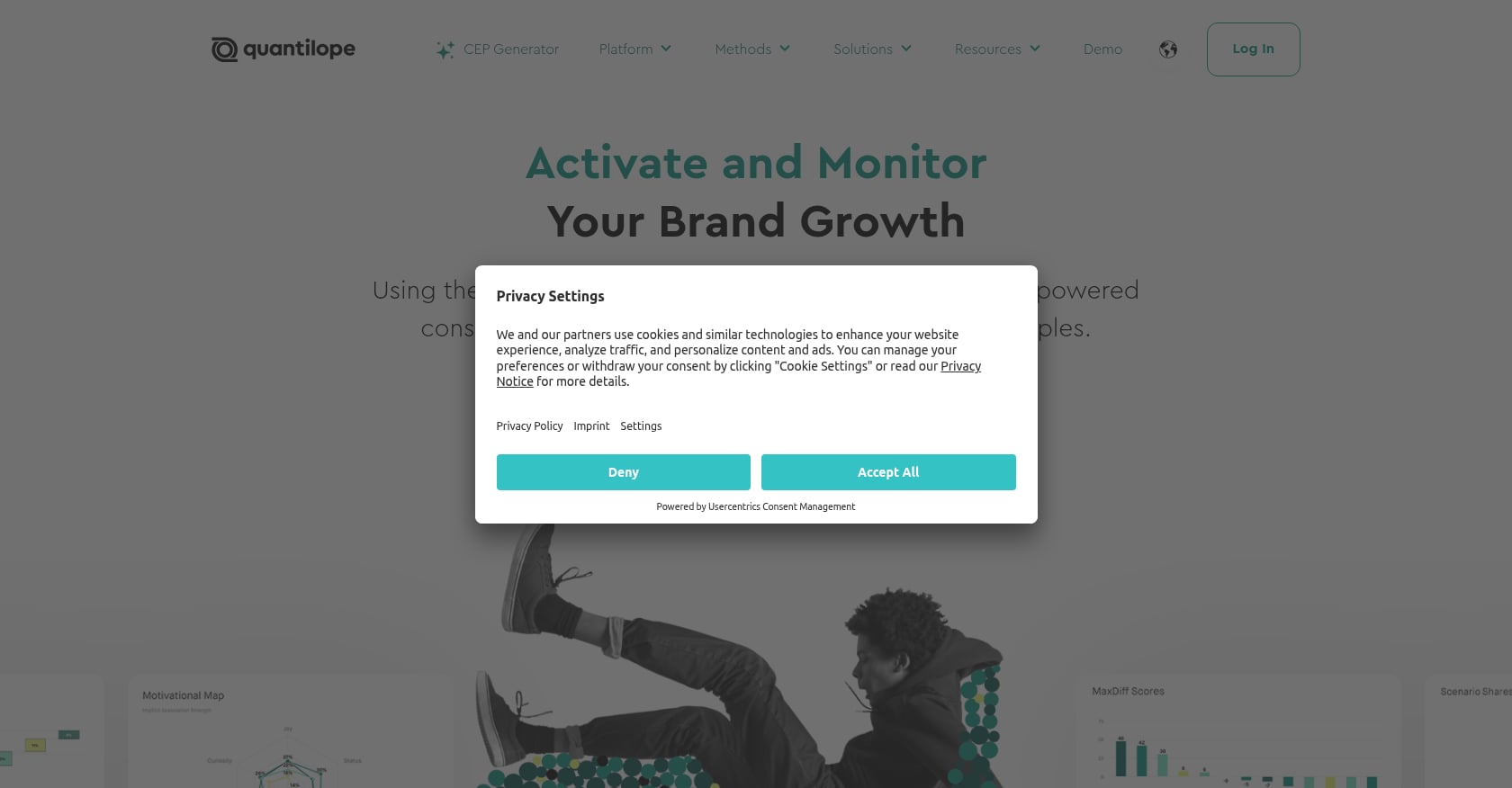
7. Quantilope
Best for: Structured quantitative research and advanced methods
Quantilope automates concept testing, brand tracking, conjoint analysis, MaxDiff, and other advanced research methods. It is built for research teams that care about methodology.
Pricing:
- Subscription-based, custom pricing (contact vendor)
Key features:
- 15 automated advanced research methods
- AI research partner for survey setup and analysis
- Real-time insights and reporting
- Panel access and broad consumer reach
Tradeoffs:
- Better for planned structured studies than ad hoc desk research
- More than most startups need for early GTM discovery
- Requires research discipline to design good studies
- Pricing likely fits mid-market and enterprise better than bootstrapped teams
User sentiment: G2’s seller profile lists Quantilope at 4.2/5 across 67 reviews.
Verdict: Use Quantilope when methodology matters and you need research you can defend in front of stakeholders or investors.
8. Dovetail
Best for: Customer interview analysis and research repositories
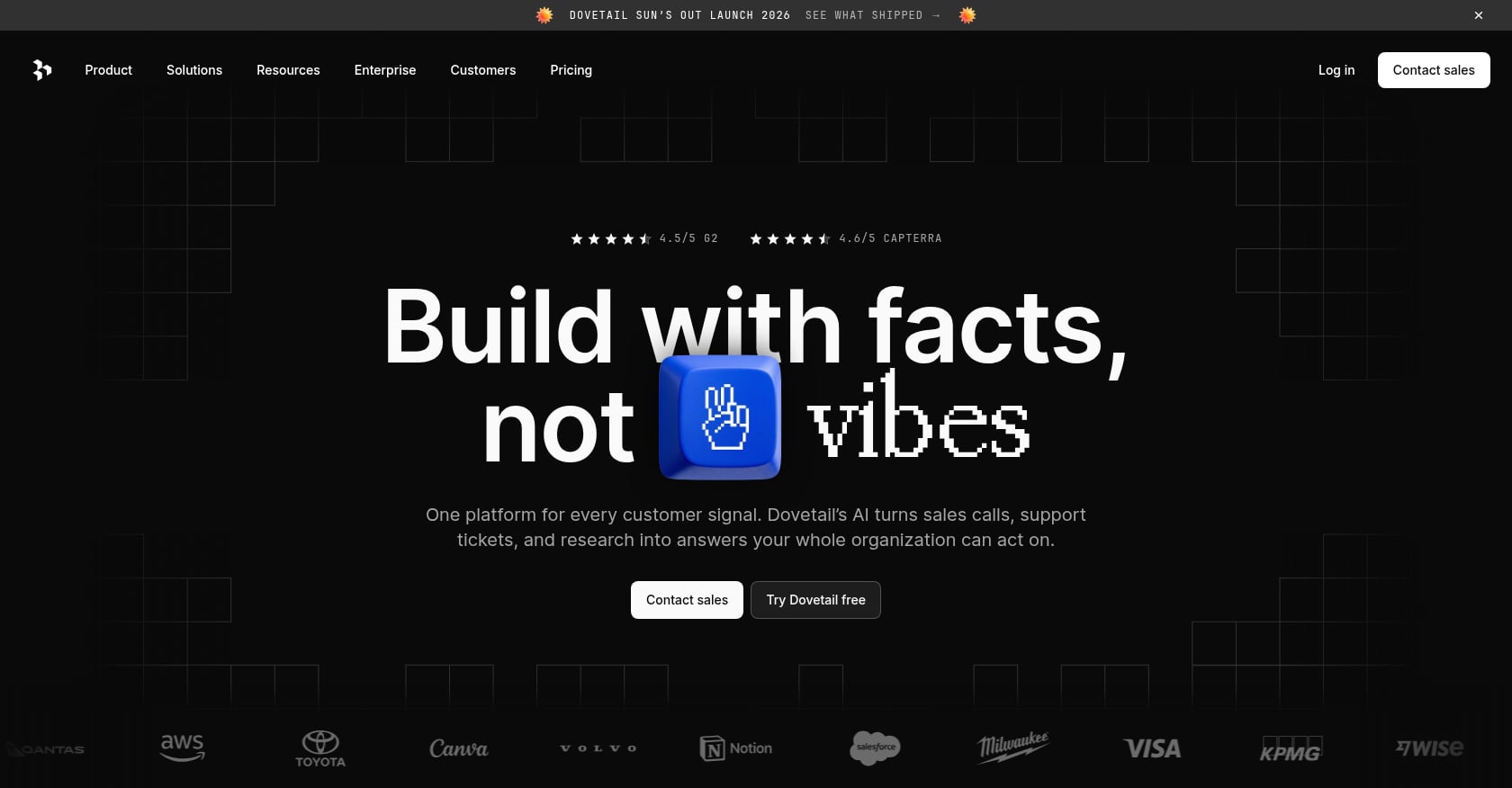
Dovetail turns messy qualitative data (interviews, calls, support tickets, survey open-ends) into searchable, tagged, shareable insights. If your team talks to customers regularly, Dovetail helps you stop losing those insights in Google Docs.
Pricing:
- Free: one channel, one project, AI summaries for a single project
- Enterprise: custom pricing with unlimited features
- Capterra lists a Professional plan at $29/user/month, but packaging has shifted; verify current availability
Key features:
- AI chat, summaries, and semantic search across research data
- Clustering and theme detection
- Slack/Teams queries for stakeholder access
- Transcription and tagging
Tradeoffs:
- Not a market discovery tool by itself; needs customer data as input
- Value depends on clean inputs and tagging discipline
- Pricing and packaging changes have frustrated some users
- AI summaries are not a substitute for reading source material
User sentiment: G2 lists Dovetail at 4.5/5 from 167+ reviews. Reddit UX research threads are more mixed, with practitioners noting that repositories become expensive and AI synthesis only works well when the data is organized.
Verdict: Dovetail is strongest after you have real customer conversations to analyze. It pairs well with tools that help you find high-intent accounts in the first place.
9. SurveyMonkey
Best for: Fast surveys and lightweight market validation
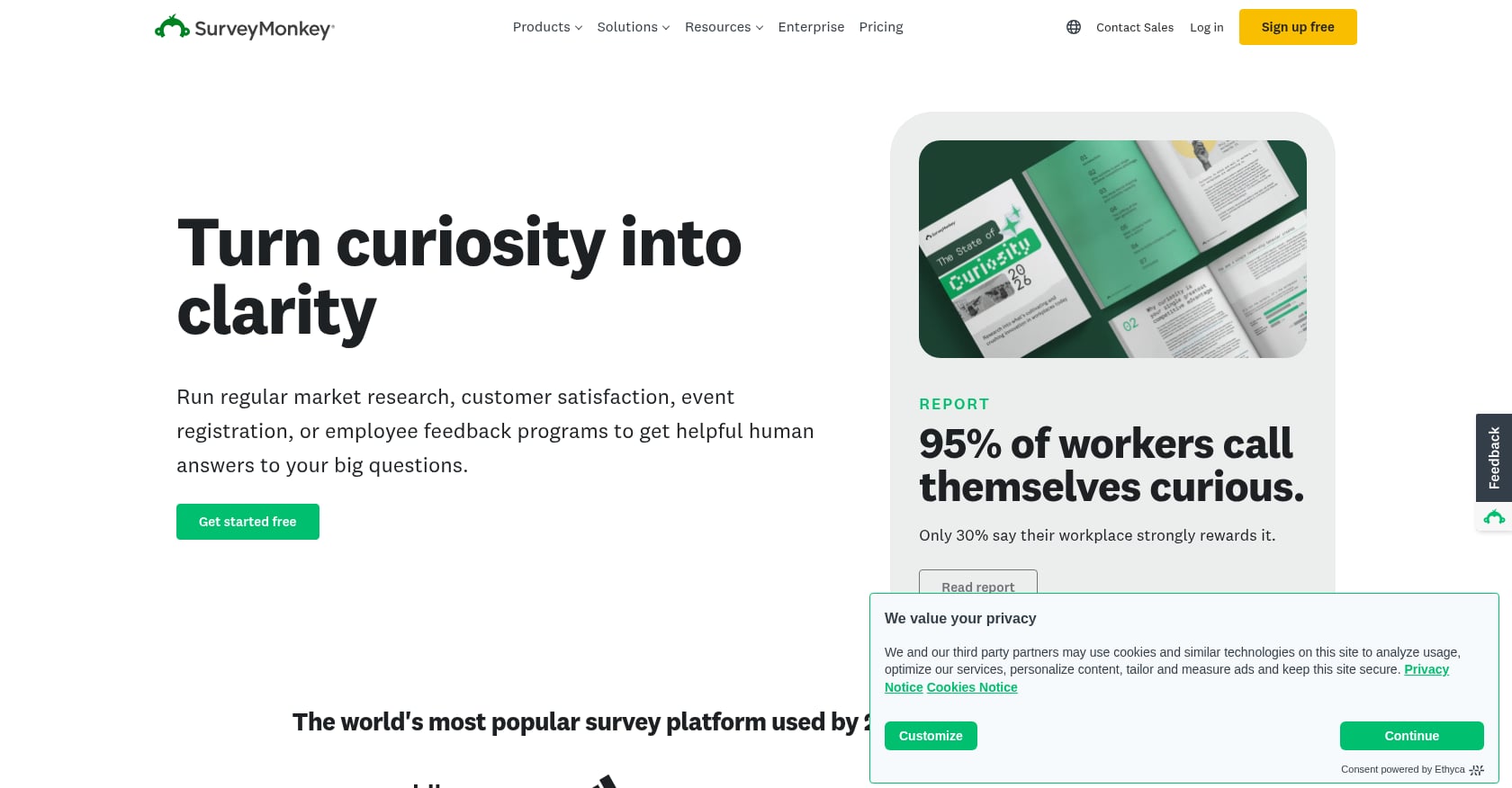
SurveyMonkey is the most widely adopted survey tool, and its AI features now help with survey creation and thematic analysis. For simple validation (“do people actually want this?”), it is a fast starting point.
Pricing:
- Basic: Free, 10 questions per survey, limited responses
- Standard Monthly: $99/month, unlimited questions, 1,000 responses/month
- Advantage Annual: $46/month ($552/year), 15,000 responses/year, Analyze with AI
- Premier Annual: $139/month ($1,668/year), 40,000 responses/year
Key features:
- Build with AI survey assistant
- Analyze with AI and thematic analysis on higher plans
- SurveyMonkey Audience for respondent recruitment (separate cost)
- Templates and branching logic
Tradeoffs:
- Free plan limits block serious use quickly
- Advanced features sit behind Advantage Annual or higher
- Survey design quality still depends entirely on the human
- Reddit users frequently complain that pricing has become restrictive for small businesses
User sentiment: G2 lists SurveyMonkey at 4.4/5 from 23,513 reviews.
Verdict: SurveyMonkey is easy to start with, but serious research quickly moves you into paid tiers.
10. Browse AI
Best for: Competitor web monitoring and public data extraction
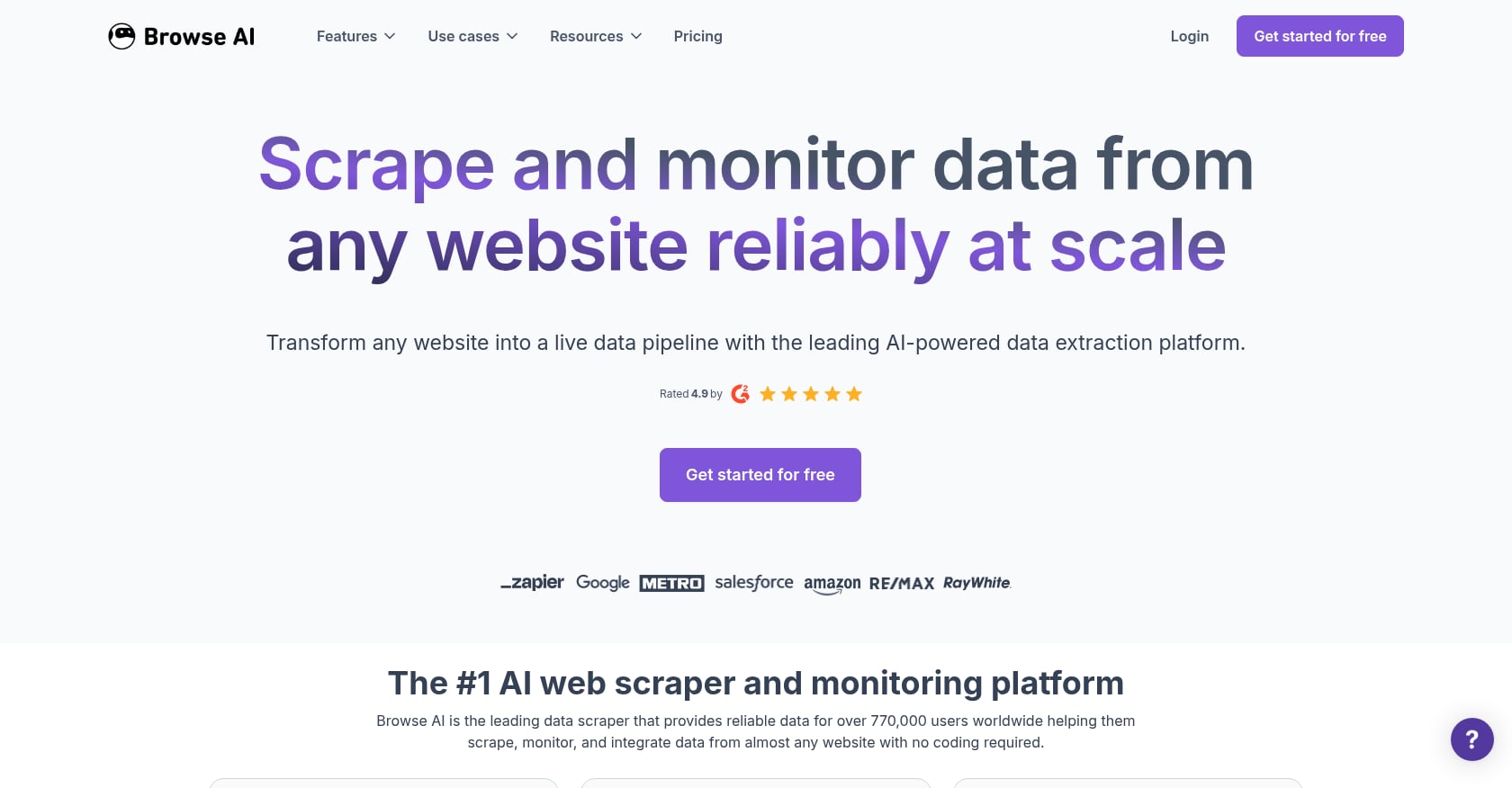
Browse AI lets you build no-code robots that scrape and monitor public websites. It is useful for tracking competitor pricing, product listings, review counts, and directory changes.
Pricing:
- Free: 50 credits/month, 2 domains
- Personal: $48/month, 2,000 credits
- Professional: $69/month, 5,000 credits
- Premium: starts at $6,000/year, managed setup
Key features:
- No-code scraping robots
- Website monitoring with change alerts
- Google Sheets and Zapier integration
- API access for automation
Tradeoffs:
- Collects data but does not interpret strategy
- Some sites block or break scraping
- Credits can disappear quickly with frequent monitoring
- Legal and terms-of-service considerations matter
User sentiment: G2 lists Browse AI at 4.8/5 from roughly 60 reviews. Users praise no-code setup but note credit limits and complex-site friction.
Verdict: Browse AI is a data collection tool, not a market research brain. Pair it with a synthesis tool to make the data useful.
Where AI Market Research Fails
AI market research tools are useful, but they fail in predictable ways. Knowing the failure modes is more valuable than knowing the feature lists.
AI can invent facts
LLMs generate plausible-sounding text. When asked about niche markets, local competitors, or specific statistics without source material, they may fabricate answers with full confidence. Always force citation or supply your own source documents.
AI summaries can remove tension
One practitioner on Reddit made a point worth remembering: AI can “sand off every tension in the data,” and that tension is often where the real insight lives. When an AI summary smooths over contradictions in customer interviews or survey responses, it may be hiding the most important finding.
Synthetic respondents are not real customers
HBR’s coverage of synthetic personas and digital twins helped push this concept into the mainstream. A 2026 arXiv paper reported 87.73% accuracy in predicting user preferences using customer digital twins in conjoint analysis. That sounds promising, but practitioner consensus is far more cautious.
On LinkedIn, ESR Research summarized the emerging view: synthetic respondents can help with early concept screening, but they fall short when research requires genuine surprise, regulatory-grade evidence, or culturally specific behavior. Reddit discussions echo this, with one researcher arguing that simulations can only operate inside the bounds of what is already known, while real interviews surface workarounds and priorities the team never predicted.
Do not use synthetic respondents as the only evidence for pricing, roadmap decisions, regulated categories, or launch strategy.
Social listening sentiment is not always accurate
Brandwatch users consistently note that automated sentiment classification needs human validation. A sarcastic tweet coded as “positive” or a complaint coded as “neutral” can distort the picture. Directional, yes. Definitive, no.
Recommended AI Market Research Stacks by Budget
Lean startup stack (under $300/month)
- AgentWeb DIY ($199/month) for research-to-execution workflows
- ChatGPT Plus ($20/month) for synthesis
- Perplexity Pro ($20/month) for sourced desk research
- SparkToro Free for audience discovery
- Manual Reddit and G2 review mining for customer language
For teams that need targeted lead generation tied to their research, AgentWeb bridges the gap between insight and outbound.
B2B SaaS growth team stack
- AgentWeb done-with-you or done-for-you for GTM execution
- Perplexity Pro for desk research
- SparkToro Personal or Business for channel research
- Dovetail for customer call analysis
- Browse AI for competitor monitoring
- SurveyMonkey Advantage for validation surveys
Teams building a repeatable content engine should also review the ContentOps for GTM guide to connect research cadence with publishing cadence.
Enterprise insights stack
- GWI Plus or Pro for consumer data
- Brandwatch for social listening
- Quantilope for structured research
- Dovetail for internal VoC repository
- AlphaSense for financial and market intelligence
Practical Workflow: 7-Day AI Market Research Sprint
Most AI market research guides explain tools but skip the workflow. Here is a sprint framework for startups that need to move from question to campaign in a week.
| Day | Activity | Tool |
|---|---|---|
| Day 1 | Define decision, ICP, and hypotheses | AgentWeb / ChatGPT |
| Day 2 | Desk research and competitor scan | Perplexity / ChatGPT |
| Day 3 | Audience and channel discovery | SparkToro / GWI |
| Day 4 | Customer-language mining | Reddit, G2 reviews, Dovetail |
| Day 5 | Survey or interview validation | SurveyMonkey / customer calls |
| Day 6 | Convert findings into messaging and assets | AgentWeb / ChatGPT |
| Day 7 | Launch test and define metrics | AgentWeb / ad and email stack |
The point is not to have perfect research by Day 7. The point is to have a testable hypothesis in market, generating real signals that replace guesswork.
Run this sprint with AgentWeb’s pre-built workflows for market research, competitive analysis, promotion planning, and audience insights.
The Research-to-Execution Gap
Most AI market research tools stop at the insight. They give you a report, a dashboard, a persona card, or a trend chart. Then what?
For startups, the real bottleneck is not research. It is turning research into action:
- ICP research needs to become outbound lists
- Competitor language needs to become positioning
- Audience insights need to become a content calendar
- Customer objections need to become landing page copy
- Social listening needs to become founder LinkedIn posts
- Trend research needs to become campaigns
This is where the tool categories in this guide break down. Survey tools do not write outbound sequences. Social listening platforms do not build ad creatives. Audience intelligence does not ship content.
AgentWeb is designed for this gap. Its self-serve platform includes templates for market research, competitive analysis, and audience insights. Its full-service model adds a Week 0 diagnostic, 90-day GTM plan, multi-channel execution, content production, founder brand support, outbound campaigns, paid ads, reporting, and weekly performance reviews. Research that does not change what your team ships is just another document.
FAQ
What is AI market research?
AI market research uses artificial intelligence, machine learning, NLP, and predictive analytics to collect, analyze, summarize, and report market and customer data faster than traditional methods. Common applications include survey automation, trend analysis, sentiment analysis, competitive intelligence, and automated reporting.
Can ChatGPT do market research?
Yes, for framing, synthesis, interview guides, summaries, and hypothesis generation. It should not be the sole source for current statistics, niche competitor lists, or claims you plan to defend to investors or leadership. Always supply source material or verify outputs independently.
What is the best AI market research tool?
It depends on the job. AgentWeb is best for startup GTM execution. Perplexity is best for cited desk research. ChatGPT is best for synthesis. SparkToro and GWI are best for audience intelligence. Brandwatch is best for enterprise social listening. Dovetail is best for customer feedback analysis.
Can AI replace market research agencies?
Not fully. AI speeds up drafting, synthesis, and analysis. But methodology design, sampling, interpretation, and defensible recommendations still need experienced humans. The strongest approach combines AI tools with human judgment and real customer conversations.
Are synthetic respondents reliable?
They are directionally useful in some contexts, particularly for early concept screening. Academic research shows promise under specific conditions. But practitioner consensus is clear: synthetic respondents should not replace real people for high-stakes decisions, “why” questions, or situations where you need to discover the unexpected.
What is the cheapest AI market research stack?
ChatGPT Plus ($20/month) for synthesis, Perplexity Pro ($20/month) for sourced research, SparkToro Free for audience discovery, SurveyMonkey Basic for simple surveys, and manual Reddit/G2 mining for customer language. Add AgentWeb DIY ($199/month with a 7-day free trial) when you need research connected to campaign execution.
What should startups avoid when using AI for market research?
Avoid buying enterprise social listening or quant platforms before knowing what decision you need to make. Avoid treating AI summaries as proof. Avoid using LLM-generated market sizing numbers in investor materials without traceable sources. And avoid the trap of researching endlessly without shipping anything to test.
How do I turn AI market research into actual campaigns?
Start with a clear decision, run a time-boxed research sprint, validate with real customer signals, then convert findings into messaging, content, and campaign assets. Tools like AgentWeb are built to close this loop, combining research workflows with multi-channel execution. Compare pricing options to find the right fit for your team.
Or get a free AI Readiness Roadmap to see where your GTM has gaps.
Ex-Meta, Google, LinkedIn. 10+ years in ML & data science for GTM. Expert in customer acquisition and growth activation.
Get a free Stack Review.
30 min with Harsha and Matt.
We audit your last 30 days, pinpoint the highest-impact fixes, and hand you the exact playbook we'd run. No deck. No pitch unless there's a fit.